Supplements
Reviewed by Dr. Nathan ColeUpdated March 2026UK market focus
Sauna Blanket vs Traditional Sauna: Which Is Better for Recovery?
Alright, fitness fanatics, weekend warriors, and anyone who's ever felt the glorious ache after a particularly brutal gym session or a long, demanding week – let's talk recovery. We all know that feeling, don't we? That stiffness, the muscle soreness, the general 'oomph' leaving your body. Well, for centuries, people have turned to heat therapy to soothe their weary bones and revitalise their spirits. And when we think of heat therapy, often the first image that springs to mind is a proper, steamy sauna.
But hold your horses! In this modern age, a new contender has entered the ring, promising similar benefits from the comfort of your own home: the sauna blanket. So, if you're looking for an edge in your recovery, or just a way to unwind and de-stress, you might be scratching your head trying to figure out which option is best for you. Is it the classic, communal warmth of a traditional sauna, or the personal, portable embrace of a sauna blanket?
This guide compares these two recovery options head-to-head, with a focus on cost, practicality, and evidence. We'll look at how they work, their pros and cons, what they'll set you back financially, and most importantly, what the science says about their effectiveness for getting you back on your feet faster.
Understanding the Benefits of Heat Therapy for Recovery
Before we pit these two titans against each other, let's quickly recap *why* heat therapy, in general, is such a cracking idea for recovery. It's not just about feeling good, you know, there's some solid science behind it.
When you expose your body to heat, a cascade of physiological responses kicks in, all geared towards repair and rejuvenation:
* **Increased Blood Circulation:** Heat causes your blood vessels to dilate, improving blood flow. This means more oxygen and vital nutrients are delivered to your tired muscles, and metabolic waste products (like lactic acid) are more efficiently carried away. Think of it like a super-charged clean-up crew for your body. A study published in the *American Journal of Medicine* by Hannuksela and Ellahham (2001) highlighted the cardiovascular benefits of sauna bathing, including improved endothelial function and blood pressure regulation.
* **Muscle Relaxation and Pain Relief:** The warmth helps to relax tight muscles, reducing tension and stiffness that often accompanies intense exercise. This relaxation can also alleviate post-workout soreness (DOMS – Delayed Onset Muscle Soreness) and general aches. Heat also stimulates the release of endorphins, your body's natural painkillers, which can significantly improve your mood and reduce discomfort.
* **Reduced Inflammation:** Some research suggests that regular heat exposure can help reduce systemic inflammation. Heat shock proteins, which are activated by heat stress, play a role in cellular repair and have anti-inflammatory effects. Crinnion (2007), in an article for *Alternative Medicine Review*, discussed how heat stress can induce beneficial physiological changes, including the activation of these protective proteins.
* **Detoxification (Sweat):** While the extent of "detoxification" through sweat is often debated, sweating profusely does help your body excrete various compounds, including heavy metals and other toxins. Even if it's primarily water and salts, the feeling of a good sweat can be incredibly cleansing and invigorating.
* **Stress Reduction and Improved Sleep:** The deep relaxation induced by heat therapy is fantastic for reducing stress. It lowers cortisol levels and promotes a sense of calm, which in turn can lead to better quality sleep – a crucial component of any effective recovery strategy.
So, whether you're an athlete pushing your limits or just someone dealing with the daily grind, incorporating heat therapy into your routine can offer a significant boost to your overall well-being and recovery process. Now, let's look at the contenders.
Traditional Saunas: The Classic Experience
When most of us picture a sauna, we're thinking of a traditional one. These are typically wooden rooms, heated to high temperatures, designed for communal or individual use. They come in a couple of main varieties:
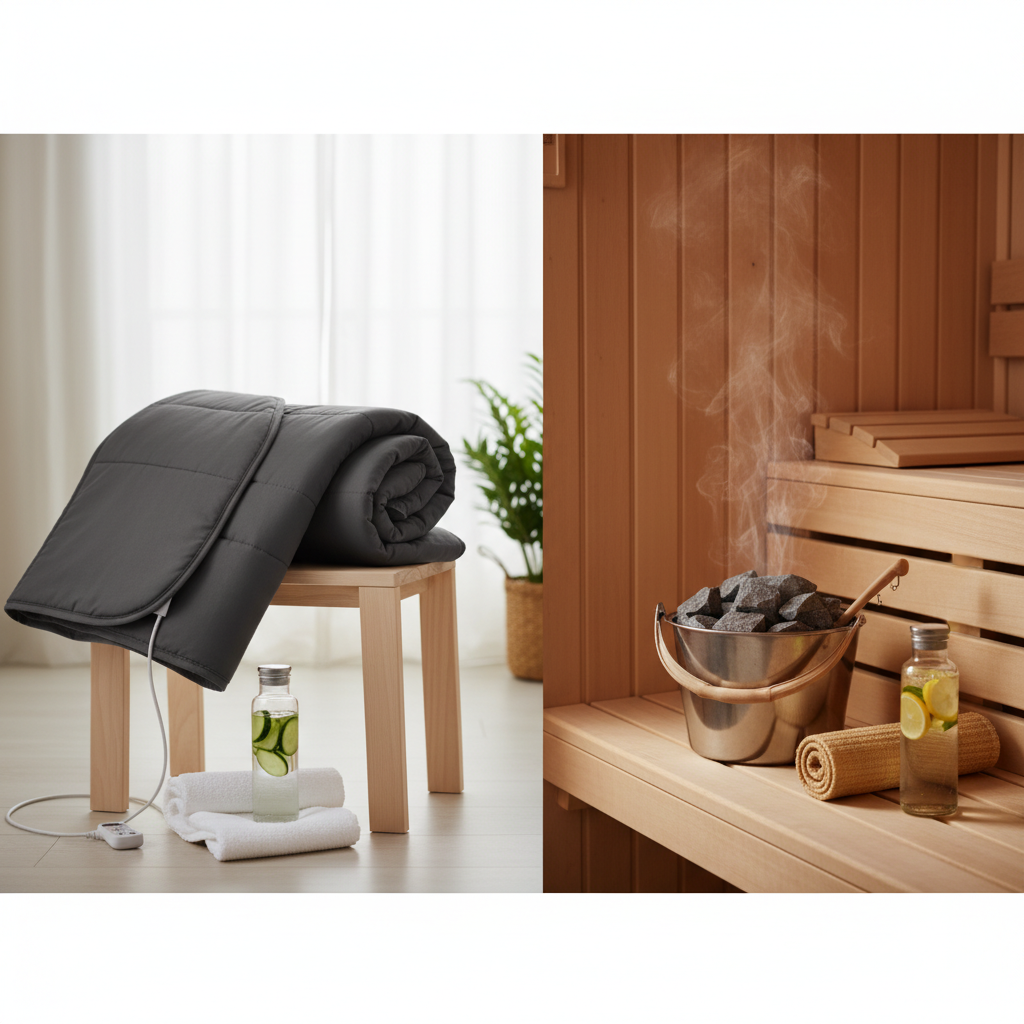
* **Finnish Saunas (Dry Saunas):** These are the most common. They use an electric heater or wood stove to heat rocks, which then radiate intense dry heat throughout the room. Temperatures typically range from 80°C to 100°C, with very low humidity (around 5-15%). You might throw a ladle of water onto the hot rocks to create a brief burst of steam, known as 'löyly', which temporarily increases humidity and intensifies the heat sensation.
* **Steam Saunas (Steam Rooms/Turkish Baths):** While often lumped in with saunas, these are technically different. They operate at lower temperatures (around 40-50°C) but with much higher humidity (close to 100%). The heat is generated by a steam generator, creating a dense, misty environment.
For the purpose of this comparison, we'll primarily focus on the classic dry sauna, as it's the most direct comparison to the heat generation methods of a sauna blanket.
How They Work
Traditional saunas heat the air around you through convection and radiation. The hot air then warms your body from the outside in. This creates a very intense, enveloping heat that penetrates tissues over time, raising your core body temperature and inducing a significant sweat response.
Pros of Traditional Saunas
* **Immersive Experience:** There's something truly special about the sensory experience of a traditional sauna. The dry heat, the smell of wood, the quiet contemplation or social interaction – it's a complete experience.
* **Intense Heat Penetration:** The high ambient temperatures ensure a thorough and deep heat penetration, warming your entire body evenly.
* **Social Aspect:** For many, a traditional sauna is a social hub, a place to relax and chat with friends or fellow gym-goers.
* **Proven Track Record:** Traditional saunas have been used for centuries, with a wealth of anecdotal evidence and growing scientific literature supporting their health benefits. Laukkanen et al. (2015) in *JAMA Internal Medicine* published a significant study linking frequent sauna bathing to reduced risk of cardiovascular disease.
* **Head-to-Toe Warmth:** Your entire body, including your head, is exposed to the heat, which some people prefer for a complete relaxation experience.
Cons of Traditional Saunas
* **Cost:** This is often the biggest hurdle. Installing a home sauna is a significant investment. You're looking at anywhere from **£3,000 for a basic kit to £10,000+ for a bespoke build**. Public sauna access can also add up, typically **£10-£30 per session** if you're not a gym member.
* **Space Requirements:** A traditional sauna needs a dedicated space, whether it's indoors or outdoors. Not ideal for smaller homes or flats.
* **Installation & Maintenance:** Installation can be complex, requiring electrical work and proper ventilation. Maintenance involves regular cleaning and occasional repairs.
* **Not Portable:** Once it's in, it's in. You can't exactly pack it up and take it with you on holiday.
* **Running Costs:** Heating a large space to 90°C consumes a fair bit of electricity. Expect to pay anywhere from **£5 to £15 per session** depending on duration, size, and your electricity tariff.
* **Public Hygiene Concerns:** If you're using a public sauna, you might have concerns about cleanliness and shared spaces.
Typical Usage & Dosages for Traditional Saunas
Most recommendations suggest staying in a traditional sauna for **10 to 20 minutes per session**. It's often advised to take breaks and cool down, potentially repeating the cycle 2-3 times. For recovery and general health, **2-3 sessions per week** are commonly recommended. Always listen to your body and exit if you feel dizzy or uncomfortable.
Sauna Blankets: The Modern Alternative
Now, let's turn our attention to the new kid on the block: the sauna blanket. These devices have gained massive popularity in recent years, largely due to their convenience and affordability. A sauna blanket is essentially a large, flexible, zip-up or velcro-fastening blanket that you lie inside, much like a sleeping bag.
How They Work
Unlike traditional saunas that heat the air, most sauna blankets use **Far Infrared (FIR) technology**. FIR is a specific wavelength of light that we perceive as heat, but it doesn't heat the air around it significantly. Instead, it penetrates the body directly, warming you from the inside out. This means you can achieve a deep sweat and an elevated core body temperature at a lower ambient air temperature, often making the experience feel less stifling than a traditional sauna.
The blanket typically contains heating elements (often carbon fibre, sometimes infused with materials like tourmaline or jade for added benefits, though the scientific evidence for these specific additions is less solid) connected to a control unit that allows you to adjust temperature and session duration.
Pros of Sauna Blankets
* **Affordability:** This is a huge selling point. A good quality sauna blanket will typically set you back anywhere from **£150 to £600**, making it a far more accessible option than a home sauna.
* **Portability & Space-Saving:** This is probably their biggest advantage. They fold up relatively small and can be stored in a cupboard or under a bed. Perfect for those with limited space or who want to take their heat therapy on the go.
* **Privacy & Hygiene:** You get your own personal sauna experience, in your own home, completely private. No sharing with strangers, no hygiene worries.
* **Direct Infrared Heat:** Proponents argue that FIR heat penetrates deeper into muscle tissue, potentially offering more targeted relief. Some studies, like Mero et al. (2015) in the *Journal of Strength and Conditioning Research*, have shown positive effects of infrared saunas on neuromuscular recovery after endurance exercise.
* **Lower Running Costs:** Because they only heat your body directly and not a large room, the energy consumption is much lower. A typical 30-60 minute session might cost you a mere **£0.50 to £1.50** in electricity, depending on wattage and tariff.
* **Convenience:** Simply unroll, plug in, set the temperature, and zip yourself in. It's ready in minutes.
Cons of Sauna Blankets
* **Restrictive Feeling:** Lying inside a blanket can feel a bit restrictive for some, especially if you're claustrophobic.
* **Less Immersive:** While relaxing, it doesn't have the same 'experience' factor as a traditional wooden sauna. You're lying down, often with your head outside the blanket.
* **Cleaning Can Be Fiddly:** Sweating heavily inside a blanket means it needs regular cleaning. Wiping down the interior takes time, although most are made with waterproof materials that are relatively easy to maintain.
* **Head Not Heated:** Your head generally remains outside the blanket. Some prefer this for comfort, but others miss the full-body heat sensation.
* **Material Quality Varies:** As with any popular product, there's a huge range in quality. Cheaper models might use less durable materials or less effective heating elements.
* **Potential for Uneven Heating:** While FIR is generally good, some cheaper blankets might have hotspots or cold spots if the heating elements aren't evenly distributed.
Typical Usage & Dosages for Sauna Blankets
For sauna blankets, sessions are often a bit longer than traditional saunas, typically ranging from **30 to 60 minutes**. Due to their convenience and potentially gentler heat, many users opt for **3-4 sessions per week**, or even daily for specific recovery goals. Always start with lower temperatures and shorter durations to see how your body reacts.
Direct Comparison: Blanket vs. Traditional (Key Differences)
Let's lay out the main differences side-by-side to help you decide.
* **Heat Type & Sensation:**
* **Traditional:** Convective and radiant heat, warming the air first, then your body. Intense, enveloping heat, often feels 'dry'.
* **Blanket:** Far-infrared (FIR) heat, penetrating your body directly. Warms from the inside out, often feels less stifling, lower ambient air temperature around you.
* **Temperature Range:**
* **Traditional:** 80°C - 100°C (dry sauna).
* **Blanket:** Typically up to 60-75°C, but the direct FIR penetration means you achieve similar core temperature elevation and sweat at lower air temperatures.
* **Portability & Space:**
* **Traditional:** Zero portability, requires significant dedicated space.
* **Blanket:** Highly portable, folds away for easy storage, perfect for small living spaces.
* **Cost (Initial):**
* **Traditional:** High, £3,000 - £10,000+ for home installation.
* **Blanket:** Low, £150 - £600.
* **Cost (Running per session):**
* **Traditional:** Moderate to high, £5 - £15.
* **Blanket:** Low, £0.50 - £1.50.
* **Experience & Social Aspect:**
* **Traditional:** Immersive, full-body heat, potentially social.
* **Blanket:** Personal, private, often feels more functional than experiential, head usually outside.
* **Maintenance:**
* **Traditional:** Requires specific cleaning, ventilation, potential repairs.
* **Blanket:** Wiping down interior after each use, relatively low maintenance otherwise.
* **Setup Time:**
* **Traditional:** Long initial installation. Instant use once heated (which can take 30-60 mins).
* **Blanket:** Minutes to unroll and heat up.
Scientific Evidence: What Do Studies Say?
The general benefits of sauna use for recovery, cardiovascular health, and pain relief are well-documented for traditional saunas. Studies consistently show positive effects on blood pressure, endothelial function, and muscle soreness.
When it comes to infrared saunas (which sauna blankets utilise), the research is also promising, though perhaps slightly less extensive than for traditional saunas, simply because they're a newer technology.
Several studies have investigated FIR saunas for recovery:
* A 2015 study by Mero et al. published in the *Journal of Strength & Conditioning Research* found that **far-infrared sauna use enhanced neuromuscular recovery after maximal endurance effort**. Participants reported reduced muscle soreness and faster recovery of muscle function.
* Another review by Hussain and Cohen (2018) in *Clinical Rheumatology* looked at infrared sauna therapy for chronic pain conditions like rheumatoid arthritis and fibromyalgia, suggesting that it could be a **safe and effective way to reduce pain and stiffness**. While not directly about athletic recovery, the mechanisms of pain relief and muscle relaxation are highly relevant.
* Many researchers suggest that the key to the benefits of both types of saunas lies in the **elevation of core body temperature and the subsequent physiological responses** (increased heart rate, blood flow, sweating, heat shock protein activation). While FIR saunas achieve this at lower ambient air temperatures, the end result on the body can be quite similar to traditional saunas if used correctly for sufficient duration.
So, while traditional saunas have a longer history and more epidemiological data, the emerging science for infrared technology, particularly for recovery, is strong. Both methods appear to be effective ways to harness the benefits of heat therapy.