Supplements
Reviewed by Dr. Nathan ColeUpdated March 2026UK market focus
Theragun vs Hyperice: Which Massage Gun Wins in 2025?
Right, listen up, fitness fanatics, weekend warriors, and anyone who’s ever woken up feeling like they’ve wrestled a badger in their sleep. We’re in 2025 now, and the world of recovery tech has moved on a fair bit. Gone are the days when a foam roller and a good stretch were your only options for easing those aching muscles. Enter the massage gun – a percussive therapy device that's become as essential to many a gym bag as a decent pair of trainers.
These handheld marvels promise to boost recovery, reduce soreness, increase your range of motion, and generally make you feel a bit more sprightly. But with so many brands out there, how do you choose? Well, two names consistently dominate the conversation: Theragun and Hyperice. They’re the Apple and Samsung of the recovery world, constantly innovating and vying for the top spot.
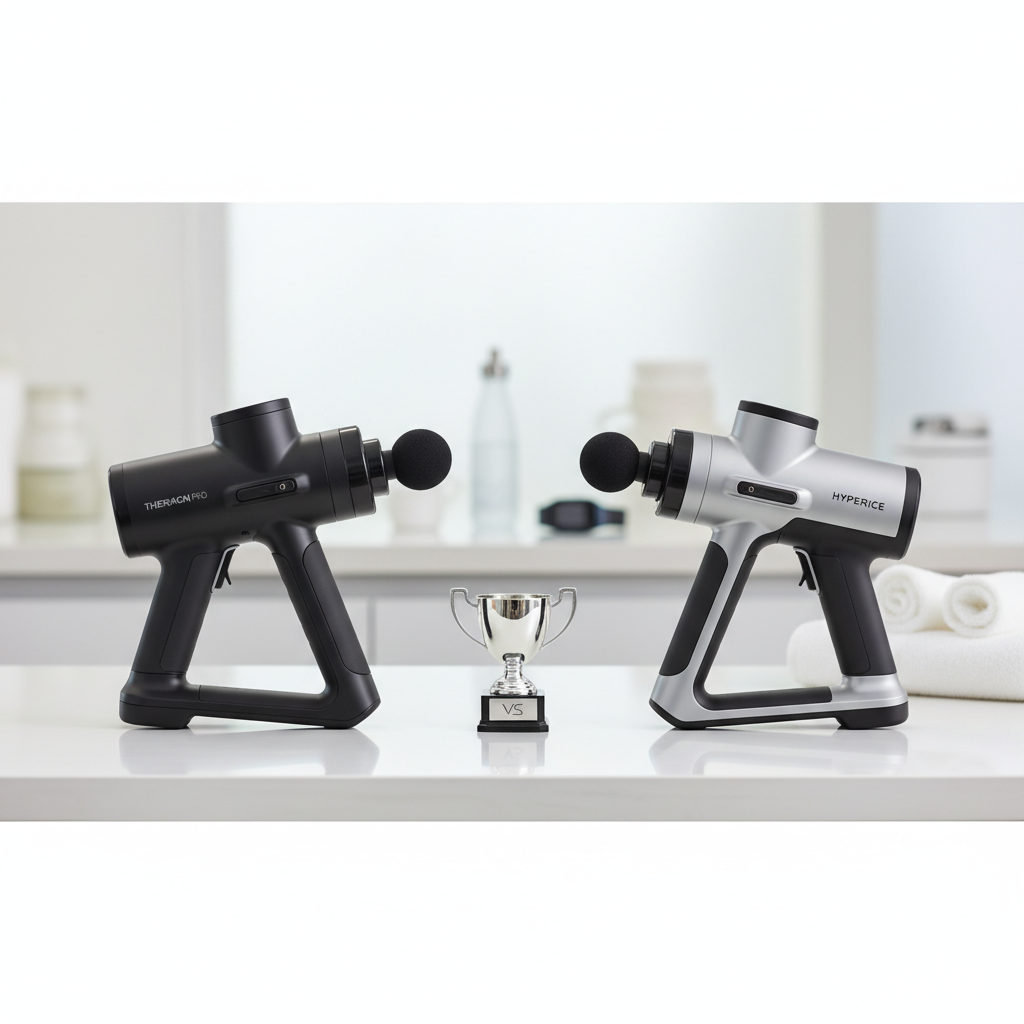
This comparison looks at Theragun and Hyperice head to head, with a focus on power delivery, ergonomics, attachment quality, noise, battery life, and value.
Why Massage Guns? The Science Behind the Buzz
Before we get into the nitty-gritty of Theragun versus Hyperice, let’s quickly touch on *why* these gadgets have become so popular. It’s not just hype, mate; there’s some solid science behind percussive therapy.
Essentially, a massage gun delivers rapid, repetitive strokes (percussions) deep into your muscle tissue. This isn't just a surface-level vibration; it's designed to penetrate and stimulate blood flow. Think of it like a concentrated, high-speed deep tissue massage.
So, what are the benefits?
* **Reduced Muscle Soreness (DOMS):** Delayed Onset Muscle Soreness, or DOMS, is that familiar ache you feel a day or two after a tough workout. Studies have indicated that percussive therapy can significantly reduce the severity and duration of DOMS. The rapid pulsations help to flush out metabolic waste products that accumulate during exercise and contribute to soreness, whilst also improving local circulation.
* **Increased Range of Motion (ROM):** Research, including a meta-analysis published in the *Journal of Sports Science & Medicine* (though specific studies vary), consistently shows that using a massage gun can improve flexibility and joint range of motion. This isn't just about stretching; the percussions help to break up adhesions in the fascia (the connective tissue surrounding muscles) and relax tight muscles, allowing for greater movement without discomfort.
* **Enhanced Blood Flow:** The rapid vibrations stimulate blood flow to the targeted area. This increased circulation brings vital oxygen and nutrients to tired muscles, accelerating the repair process and helping them recover faster.
* **Muscle Activation and Warm-up:** Before a workout, a quick blast with a massage gun can help prime your muscles. It increases blood flow, warms up the tissues, and can even improve muscle activation, potentially leading to better performance and reduced injury risk. Think of it as a targeted dynamic stretch.
* **Stress Relief and Relaxation:** Beyond the physical benefits, the sensation of a deep tissue massage can be incredibly relaxing. It helps to calm the nervous system, reduce muscle tension from everyday stress, and can even improve sleep quality. Who doesn't want a bit of that after a long day?
It's important to note that while the evidence is growing, research is still relatively young compared to other recovery modalities. However, the anecdotal evidence from athletes, physiotherapists, and everyday gym-goers is overwhelmingly positive. These devices work, and they work well.
The Contenders: A Deep Dive
Right, let’s get down to brass tacks. We’re looking at the latest and greatest from both Theragun and Hyperice, imagining what their top-tier offerings will be like in 2025, building on their current flagship models. We’ll focus on the Theragun PRO and Elite, and the Hypervolt 2 Pro and Hypervolt 2, as these represent the pinnacle and the popular mid-range options from each brand.
Theragun: The Powerhouse Performer
Theragun, now part of the Therabody family, burst onto the scene with a distinctive, almost industrial design and a promise of deep, powerful percussive therapy. They’ve always prided themselves on amplitude and force, aiming to get right into those stubborn knots.
Brand Philosophy & Design
Theragun’s philosophy has always been about therapeutic-grade percussive massage. They’re not just about vibration; they’re about amplitude and force that genuinely hits deep into the muscle tissue. Their iconic triangular handle isn't just for show; it's an ergonomic masterpiece. It allows you to hold the device in multiple ways, reaching almost any muscle on your body without awkward contortions, even your lower back or shoulder blades. This unique design is a huge differentiator and, for many, a major selling point. They also tend to lean into a more rugged, professional aesthetic.
Key Models
Let’s look at their premium and popular mid-range offerings, which we can expect to see refined in 2025.
* **Theragun PRO (5th Gen, looking ahead to 2025):**
* **Amplitude & Force:** This is where the PRO shines. We're talking about a significant 16mm amplitude – meaning the head travels 16mm into the muscle with each percussion. This is crucial for deep tissue work. It delivers up to 60 lbs (around 27 kg) of no-stall force, meaning it won't bog down even when you lean into it. Speed-wise, you’re typically looking at a range of 1750 to 2400 percussions per minute (PPM), with customisable settings via the app.
* **Battery Life:** The PRO typically comes with two swappable lithium-ion batteries, each offering around 150 minutes of use. This means you can keep one charging whilst using the other, ensuring you’re never without power.
* **Attachments:** A standard set usually includes 6-8 attachments, each designed for a specific purpose: a dampener for sensitive areas, a standard ball for general use, a thumb for trigger points, a cone for precise treatment, a wedge for scraping, and sometimes a supersoft for extra delicate areas. They’re made from closed-cell foam, which is hygienic and easy to clean.
* **Smart Features:** This is a big area for Theragun. The PRO connects neatly to the Therabody app via Bluetooth. The app is fantastic, offering guided routines tailored to specific activities (e.g., "Post-Run Recovery," "Desk Work Relief"), muscle groups, or even symptoms. It visualises the pressure you’re applying and helps you optimise your treatment. Expect even more sophisticated AI-driven personalisation in 2025.
* **Noise Level:** Historically, Theraguns have been louder than their Hyperice counterparts. Whilst they’ve made huge strides with their QuietForce Technology, they still produce a noticeable hum, especially at higher speeds. It's not disruptive like a jackhammer, but you might struggle to have a quiet chat whilst using it.
* **Price:** As a premium, professional-grade device, the Theragun PRO typically sits at the higher end of the market, usually around **£549 - £599**.
* **Materials:** Built with an industrial-grade brushless motor, solid plastics, and often a metal internal chassis, it feels incredibly durable and built to last.
* **Theragun Elite (4th Gen, looking ahead to 2025):**
* **Amplitude & Force:** The Elite offers the same 16mm amplitude as the PRO, which is impressive for a slightly less expensive model. However, its stall force is a bit lower, typically around 40 lbs (approx. 18 kg). Speed settings are similar, ranging from 1750 to 2400 PPM.
* **Battery Life:** It features an internal lithium-ion battery, usually offering around 120 minutes of continuous use, which is still cracking good.
* **Attachments:** Comes with 5 attachments, focusing on the most commonly used ones.
* **Smart Features:** Full app connectivity, guided routines, and a built-in OLED screen to display speed and force.
* **Noise Level:** Thanks to QuietForce Technology, it's quieter than older Theragun models, and often just a touch quieter than the PRO, making it a good option if noise is a concern but you still want that deep amplitude.
* **Price:** A significant step down from the PRO but still a premium product, typically around **£379 - £429**.
* **Materials:** High-quality composite plastics and a powerful brushless motor.
Pros & Cons of Theragun
**Pros:**
* **Unrivalled Deep Tissue Penetration:** The 16mm amplitude is a a strong contender for serious muscle work.
* **Unique Ergonomic Design:** The triangular handle is simply brilliant for self-use, allowing you to reach almost any body part.
* **Powerful Stall Force:** You can really lean into it without it stopping, perfect for dense muscles.
* **Excellent App Integration:** The Therabody app is incredibly comprehensive, offering personalised guidance and routines.
* **Rotating Arm:** The PRO model features a rotating arm, adding even more versatility for hard-to-reach areas.
* **Professional-Grade Build:** Feels incredibly solid and durable.
**Cons:**
* **Noise Level:** Whilst improved, it’s still generally louder than Hyperice models.
* **Price:** Definitely an investment, especially the PRO model.
* **Weight:** Can be a bit heavy for extended use, particularly the PRO.
* **Intensity:** The high amplitude can be too intense for some beginners or those with more sensitive muscles.
Hyperice: The Smooth Operator
Hyperice, much like Theragun, has been a pioneer in the recovery tech space, but they’ve often taken a slightly different approach, emphasising quietness, smoothness, and accessibility alongside effective percussive therapy.
Brand Philosophy & Design
Hyperice’s brand ethos often leans towards a more refined, quieter experience. They aim to provide powerful percussive therapy without the associated racket. Their design is more traditional, resembling a handheld drill, but with a sleek, minimalist aesthetic. They often incorporate pressure sensor technology, giving real-time feedback on how much force you’re applying. This focus on user experience and a less intrusive sound profile is a key differentiator.
Key Models
Let’s look at their flagship and popular mid-range models, which we can expect to see further refined in 2025.
* **Hypervolt 2 Pro (2025 iteration):**
* **Amplitude & Force:** The Hypervolt 2 Pro offers a very respectable 14mm amplitude, which is still excellent for deep tissue work, though slightly less than Theragun’s 16mm. It boasts a powerful 90W high-torque motor, delivering a good amount of stall force, typically around 40-50 lbs (approx. 18-22 kg). Speed settings are usually between 1700 and 2700 PPM across 5 variable speeds.
* **Battery Life:** Features an internal lithium-ion battery, often providing around 3 hours (180 minutes) of use on a single charge, which is fantastic.
* **Attachments:** Typically comes with 5 interchangeable head attachments: fork, ball, cushion, flat, and bullet, made from durable, hygienic materials.
* **Smart Features:** Connects to the Hyperice App via Bluetooth, which offers guided routines and programmes. A key feature is the built-in pressure sensor, which displays on an LED ring how much force you’re applying, helping you to optimise your treatment and avoid pressing too hard.
* **Noise Level:** This is where Hyperice typically shines. Thanks to its QuietGlide technology, the Hypervolt 2 Pro is remarkably quiet, even at higher speeds. You can easily have a conversation or watch TV whilst using it.
* **Price:** As a premium device, it’s positioned competitively against the Theragun Elite, usually around **£369 - £419**.
* **Materials:** Constructed with high-quality, lightweight composite materials, giving it a premium feel whilst keeping the weight down.
* **Hypervolt 2 (2025 iteration):**
* **Amplitude & Force:** The Hypervolt 2 is lighter and more compact, offering a 12mm amplitude. This is still effective for most users but less deep than the PRO models. It has a good stall force for its size, but less than the Pro. Speed settings typically range from 2000 to 2700 PPM across 3 speeds.
* **Battery Life:** An internal lithium-ion battery provides around 3 hours (180 minutes) of use, which is very impressive for a smaller device.
* **Attachments:** Comes with 5 attachments, similar to the Pro, but without the pressure sensor feedback on the device itself.
* **Smart Features:** Bluetooth connectivity to the Hyperice App for guided routines.
* **Noise Level:** Incredibly quiet, even quieter than the Pro model due to its smaller motor. It’s one of the quietest massage guns on the market.
* **Price:** A very popular mid-range option, usually around **£279 - £329**.
* **Materials:** Lightweight, durable composite materials.
Pros & Cons of Hyperice
**Pros:**
* **Exceptional Quietness:** Hyperice devices are renowned for their QuietGlide technology, making them far less intrusive.
* **Smooth Operation:** They deliver a very smooth, consistent percussion feel.
* **Excellent Battery Life:** Often boasts longer battery life per charge than Theragun (though Theragun PRO has swappable batteries).
* **Pressure Sensor (Pro model):** The LED pressure sensor is a brilliant feature for optimising your treatment and preventing overuse.
* **Lighter Weight:** Generally lighter and more portable, especially the Hypervolt 2.
* **Competitive Pricing:** Offers strong performance at a slightly more accessible price point for its Pro model compared to the Theragun PRO.
**Cons:**
* **Less Amplitude/Depth:** The 12-14mm amplitude is good, but doesn't quite match Theragun's 16mm for ultimate deep tissue penetration.
* **Traditional Handle:** The standard 'drill-like' handle can make it harder to reach certain areas on your back or shoulders without assistance.
* **App Can Be Less Intuitive:** Whilst good, some users find the Hyperice app slightly less polished or comprehensive than the Therabody app.
* **Less Stall Force (especially Hypervolt 2):** May bog down a little more if you apply very heavy pressure compared to the Theragun PRO.
Head-to-Head Comparison: The Key Metrics
Alright, let's stack them up directly across the most important criteria.
Power and Amplitude: Who Goes Deeper?
This is Theragun’s undisputed domain. The **Theragun PRO and Elite boast a 16mm amplitude**, which means the massage head travels further into the muscle with each stroke. This is crucial for truly deep tissue work and breaking down stubborn knots. Hyperice, with its **14mm (Hypervolt 2 Pro) and 12mm (Hypervolt 2) amplitudes**, is still very effective and powerful, but it doesn't quite reach the same depth.
* **Winner: Theragun** for sheer depth and force.
Noise Level: Who's Quieter?
If you value peace and quiet, this is a clear win for Hyperice. Their **QuietGlide technology** is genuinely impressive. You can use a Hypervolt device in a quiet room without feeling like you're operating heavy machinery. Theragun has made huge strides with its QuietForce Technology, but it still produces a more noticeable hum, especially at higher settings.
* **Winner: Hyperice** by a significant margin.
Ergonomics and Handling: Personal Preference Reigns
This is highly subjective. **Theragun’s unique triangular handle** with its rotating arm (on the PRO) offers unparalleled versatility for self-treatment. You can grip it in multiple ways to hit almost any angle on your body. However, some find its bulk and weight a bit much. **Hyperice’s more traditional 'gun' handle** is comfortable and familiar, and generally lighter, but it can be a bit awkward to reach certain spots on your back or shoulders without help.
* **
Verdict: A Tie.** Depends entirely on your body shape, flexibility, and preference for reaching different areas. Try them both if you can!
Battery Life: Keeping You Going
Both brands offer excellent battery life. The **Hypervolt 2 Pro and Hypervolt 2 typically boast around 3 hours (180 minutes)** on a single charge. The **Theragun Elite offers 120 minutes**, whilst the **Theragun PRO offers 150 minutes per battery, but crucially, comes with two swappable batteries**, giving you 300 minutes total and continuous use.
* **Winner: Hyperice** for single-charge duration, but **Theragun PRO** for total available use and continuous operation thanks to swappable batteries. It's close!
Attachments: Variety and Purpose
Both brands offer a good range of attachments designed for different muscle groups and treatment intensities. **Theragun usually includes 6-8 attachments**, often made of closed-cell foam, which is firm but forgiving. **Hyperice typically provides 5 attachments**, often a mix of harder plastics and softer rubberised options. Both sets are effective and cater to most needs. Theragun's rotating arm on the PRO adds an extra dimension to attachment use.
* **
Verdict: A Tie.** Both offer comprehensive attachment sets.
Smart Features and App Integration: Guiding Your Recovery
Both brands have excellent apps that connect via Bluetooth to their devices. The **Therabody app** is arguably a bit more sophisticated, offering very detailed guided routines based on your activities, muscle groups, and even specific body parts. It also visualises the pressure you're applying in real-time. The **Hyperice app** is also very good, providing guided sessions, and the Hypervolt 2 Pro's on-device pressure sensor is a fantastic piece of tech.
* **Winner: Theragun** by a whisker for the depth and breadth of its app-guided routines and real-time pressure visualisation within the app.
Price and Value for Money: Bang for Your Buck
This is often a deciding factor.
* **Theragun PRO:** £549 - £599
* **Theragun Elite:** £379 - £429
* **Hypervolt 2 Pro:** £369 - £419
* **Hypervolt 2:** £279 - £329
Generally, Hyperice offers slightly more competitive pricing, especially when comparing their Pro model to Theragun’s Elite. The Theragun PRO is the most expensive of the lot, reflecting its professional-grade power and features.
* **Winner: Hyperice** for overall value, offering excellent features at slightly more accessible price points.
Build Quality and Materials: Built to Last
Both brands use high-quality materials and solid construction. **Theragun** often feels more 'industrial' and heavy-duty, particularly the PRO, which has a very solid, professional feel. **Hyperice** devices feel premium too, but tend to be lighter and perhaps a touch more refined in their finish. Both are designed to withstand regular, rigorous use.
* **
Verdict: A Tie.** Both are exceptionally well-built.
Practical Tips for Using a Massage Gun
Getting a massage gun is one thing; knowing how to use it effectively is another. Here are some practical tips to help you get the most out out of your device, whether it's a Theragun or a Hyperice:
1. **Start Slow and Low:** Especially if you're new to percussive therapy, begin with the lowest speed setting and the most forgiving attachment (like the dampener on a Theragun or the cushion on a Hypervolt). You can always increase intensity as your body adapts.
2. **Don't Press Too Hard:** The gun does the work. You don't need to push it deep into your muscles. Let the percussions do their job. If you have a Hypervolt 2 Pro, use the pressure sensor feedback to guide you. If you feel pain, ease off immediately.
3. **Glide, Don't Jab:** Move the massage gun slowly and continuously over the muscle. Don't hold it in one spot for too long, as this can cause discomfort or bruising. Imagine you’re painting a wall, smoothly covering the area.
4. **Avoid Bones, Joints, and Sensitive Areas:** Never use a massage gun directly on bones, joints, tendons, or areas with cuts, bruises, or varicose veins. Stay focused on muscle tissue. Also avoid your neck, particularly the front and sides, where there are delicate structures.
5. **Listen to Your Body:** This is the golden rule. If something feels wrong or painful, stop. Everyone's pain tolerance and muscle sensitivity are different.
6. **Hydrate:** Percussive therapy can help release toxins from your muscles. Drinking plenty of water before and after your session can help flush these out and aid recovery.
7. **When to Use It (Dosages):**
* **Warm-up (Pre-Workout):** Use for 30-60 seconds per muscle group you plan to work. This helps increase blood flow and activate muscles. Keep the movement dynamic.
* **Cool-down (Post-Workout):** Use for 60-90 seconds per muscle group. This helps reduce muscle soreness and aid recovery. Keep the gun moving over the muscle belly.
* **General Soreness/Tightness:** For specific tight spots or general aches, spend 1-2 minutes per muscle group. You can hold it on a trigger point for 10-15 seconds at a time, but keep it moving slightly.
* **Daily Maintenance:** A quick 1-2 minute session on key areas (e.g., shoulders, lower back, glutes) can help relieve everyday tension.
8. **Use the App:** Both Theragun and Hyperice have excellent apps with guided routines. These are invaluable for beginners and experienced users alike, taking the guesswork out of how and where to use the device. Follow their programmes for optimal results.
Scientific Backing: What Do the Studies Say?
As mentioned earlier, the science of percussive therapy is a growing field, but the existing research paints a promising picture. It's not just a fad; there are genuine physiological benefits.
Several studies have explored the impact of massage guns on various aspects of physical performance and recovery. For instance, research published in journals like the *Journal of Clinical & Diagnostic Research* and the *Journal of Sports Science & Medicine* has consistently indicated that percussive therapy can be effective in:
* **Increasing Range of Motion (ROM):** Multiple studies have demonstrated that even a short application of percussive therapy (e.g., 5 minutes on a specific muscle group) can lead to an immediate and significant improvement in joint ROM without negatively impacting muscle strength or power. This is thought to be due to reduced muscle stiffness and increased tissue elasticity.
* **Reducing Delayed Onset Muscle Soreness (DOMS):** While not always superior to traditional massage, percussive therapy has been shown to be effective in mitigating the symptoms of DOMS. It helps by increasing local blood flow, which aids in the removal of metabolic by-products, and by reducing muscle tension and inflammation post-exercise.
* **Enhancing Muscle Performance:** Some preliminary research suggests that using a massage gun as part of a warm-up routine can improve muscle performance, power output, and jump height. This is likely due to the increased blood flow and muscle activation that percussive therapy provides.
* **Improving Flexibility:** Beyond just ROM, the mechanical stimulation from massage guns helps to increase the extensibility of muscle fibres and fascia, contributing to overall better flexibility.
It's important to approach these findings with a balanced perspective. While the results are encouraging, many studies are relatively small, and more large-scale, long-term research is needed to fully understand all the mechanisms and optimal application protocols. However, the current body of evidence strongly supports the use of massage guns as a valuable tool for warm-up, recovery, and general muscle maintenance. They are not a magic bullet, but they are a highly effective adjunct to a comprehensive fitness and recovery regimen.