Supplements
Reviewed by Dr. Nathan ColeUpdated March 2026UK market focus
Bowflex vs PowerBlock: Which Adjustable Dumbbells Are Better?
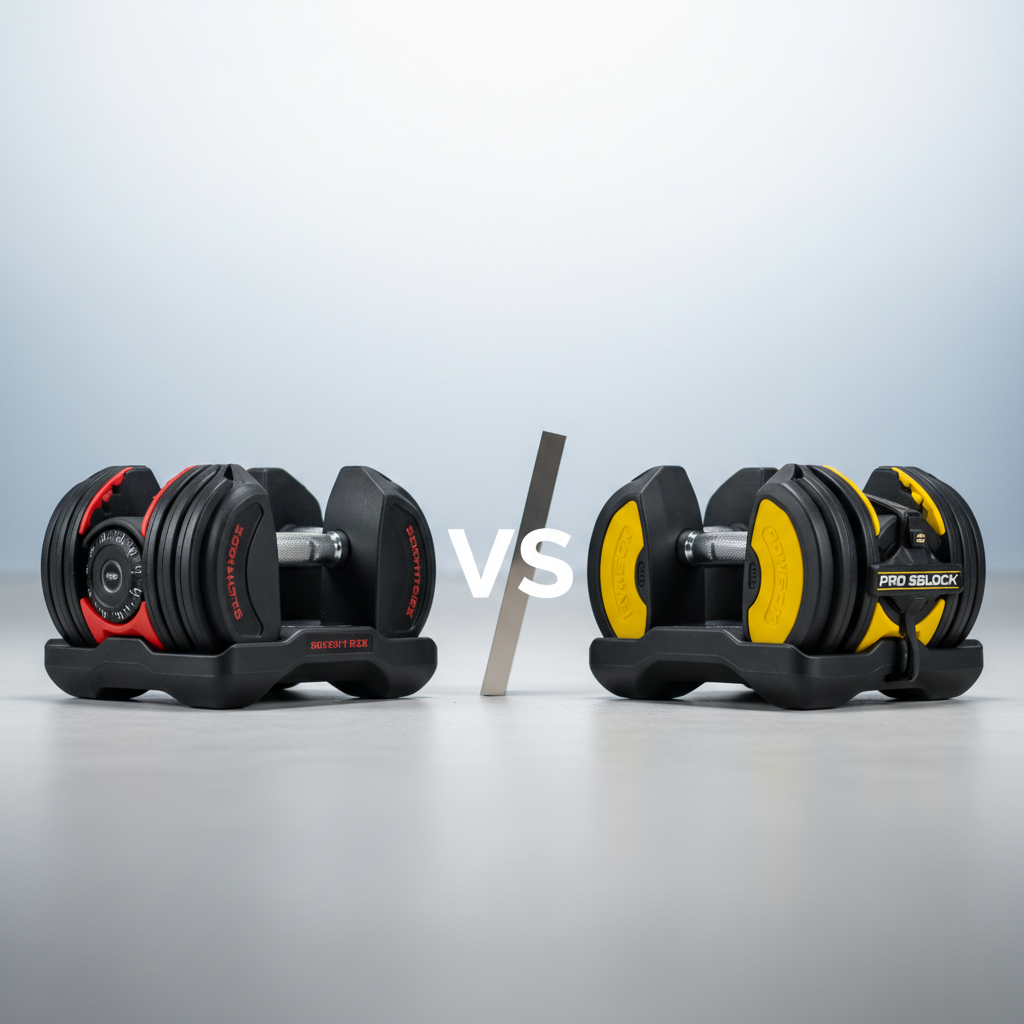
Adjustable dumbbells solve a real problem for home training: they save space, reduce cost versus full fixed sets, and make progressive overload far more practical in smaller rooms. This comparison looks at Bowflex and PowerBlock from a UK buyer's perspective.
That's where adjustable dumbbells swan in, looking like the absolute saviours of the home gym. They promise to give you the functionality of an entire rack of weights, all neatly condensed into a couple of compact units. And when we talk about adjustable dumbbells, two names inevitably pop up louder than all the rest: Bowflex and PowerBlock. They're the big players, the heavyweights (pun absolutely intended) in this particular corner of the fitness market.
But here's the kicker: they're not cheap. Investing in a pair of either Bowflex or PowerBlock dumbbells is a significant financial outlay, often setting you back several hundred quid. So, you want to make sure you're getting the right ones for you, your workouts, and your budget. No one wants buyer's remorse when it comes to their fitness gear, do they?
I've spent a fair bit of time lifting, dropping (carefully, mind), and pondering over both of these titans, and I'm here to give you the full lowdown. We'll dig into their designs, their quirks, their pros and cons, and ultimately, help you figure out which set will be your steadfast training partner for years to come. So, settle in, get comfy, and let's break it down!
Why Adjustable Dumbbells Are a Home Gym A noticeable difference
Before we dive into the nitty-gritty of Bowflex versus PowerBlock, let's just briefly touch on *why* adjustable dumbbells are such a brilliant invention in the first place. Beyond the obvious space-saving, which is huge for most of us in the UK with our often-cosy living situations, they offer incredible versatility.
Think about it: one minute you're doing bicep curls with a manageable weight, the next you're switching to heavy dumbbell rows, and then perhaps lighter lateral raises. With a fixed set of dumbbells, you'd need multiple pairs cluttering up your floor. Adjustable dumbbells allow you to transition cleanly between exercises and weight intensities without breaking your flow, or your bank balance quite as drastically as buying individual pairs. This efficiency is key for maintaining workout intensity and consistency, which, let's be honest, is half the battle when trying to stick to a fitness routine.
Furthermore, from a health perspective, resistance training with dumbbells is incredibly beneficial. Studies, such as those often published in the *Journal of Strength and Conditioning Research*, consistently demonstrate that regular strength training can lead to increased muscle mass, improved bone density, better metabolic health, and even enhanced cognitive function. Having a versatile set of dumbbells at home removes many barriers to getting started or staying consistent with this vital form of exercise.
Bowflex SelectTech Dumbbells: The Smooth Operator
Bowflex, a brand synonymous with home fitness, really made a splash with their SelectTech dumbbells. They're probably the most recognisable adjustable dumbbells out there, with their sleek, almost futuristic design. The idea is simple: turn a dial, and plates magically lock into place. It's a bit like something out of a sci-fi film, and for many, it's incredibly appealing.
Key Models and Design
The most popular models you'll encounter are the **Bowflex SelectTech 552i** and the **Bowflex SelectTech 1090i**.
* **Bowflex SelectTech 552i:** This is the entry-point for most people. It replaces 15 sets of weights, offering a range from **2 kg to 24 kg** (5 to 52.5 lbs) per dumbbell. The adjustments start at 2 kg, then go to 3 kg, 4 kg, 5 kg, 7 kg, 8 kg, 9 kg, 11 kg, 14 kg, 16 kg, 18 kg, 20 kg, 22 kg, and finally 24 kg. These increments are initially quite fine, which is great for progressive overload, but they do jump up a fair bit in the middle range.
* **Bowflex SelectTech 1090i:** For those who need more heft, the 1090i is the big brother. It replaces 17 sets of weights, ranging from **4 kg to 41 kg** (10 to 90 lbs). The increments are 4 kg, 7 kg, 9 kg, 11 kg, 14 kg, 16 kg, 18 kg, 20 kg, 23 kg, 25 kg, 27 kg, 30 kg, 32 kg, 34 kg, 36 kg, 39 kg, and 41 kg. As you can see, the jumps are larger, which is expected with heavier weights.
Both models operate using the same dial-and-lock mechanism. You place the dumbbell in its cradle, turn a dial on each end of the handle to select your desired weight, and then lift. The selected weight plates attach to the handle, while the unselected plates remain in the cradle. It's a very intuitive system.
Materials and Durability
Bowflex dumbbells are predominantly made from a combination of steel plates and heavy-duty plastic mouldings. The plates themselves are metal, but the mechanism and outer casing of the cradle are plastic. The handle is usually a textured rubber or metal for grip, which is generally comfortable.
Durability is often a point of discussion with Bowflex. While they feel solid enough for controlled lifts, they aren't designed to be dropped. The plastic components, while sturdy, are susceptible to cracking if repeatedly impacted. This means you need to be mindful when putting them down, especially after a gruelling set when your muscles are screaming. They're built for careful home use, not for the rough and tumble of a commercial gym.
User Experience
In hand, the Bowflex dumbbells feel quite balanced. The handles are comfortable, though the length of the dumbbell remains constant regardless of the weight selected. This means even if you're only lifting 5kg, you're still wielding a dumbbell that's the full length of its maximum weight capacity. This can feel a bit cumbersome for certain exercises, especially those requiring a closer grip or faster movement, like hammer curls or overhead triceps extensions.
The adjustment process is smooth and relatively quick. Turning the dial usually clicks into place satisfyingly. However, you need to ensure both dials are set to the exact same weight, or you'll lift an unbalanced weight (which is a rookie error, but one I've definitely made when rushing!). The click-and-go system is great for super-sets or circuit training where quick transitions are important.
One slight drawback, particularly with the 552i, is the larger jumps in weight in the middle of its range. Going from 11kg to 14kg can feel like a significant leap when you're trying to gradually increase your strength.
Bowflex SelectTech 552i Pricing (UK)
A pair of Bowflex SelectTech 552i dumbbells typically retails in the UK for around **GBP 350 - GBP 450**, depending on sales and retailers. Sometimes they come with a stand bundled, which adds to the price but can be a worthwhile investment for ergonomics and tidiness.
Bowflex SelectTech 1090i Pricing (UK)
The heavier 1090i set is considerably more expensive, usually in the range of **GBP 650 - GBP 800** for a pair. Again, stands are often sold separately or as part of a more expensive bundle.
Pros of Bowflex SelectTech Dumbbells
* **Sleek, compact design:** Looks great in a home gym and takes up minimal space.
* **Very quick and easy weight adjustment:** Just turn a dial, lift, and go. Ideal for supersets or drop sets.
* **Comfortable grip:** Handles are generally well-designed and comfortable.
* **Good weight range:** Especially the 552i for beginners to intermediate lifters.
* **Often includes a one-year warranty:** Provides some peace of mind.
Cons of Bowflex SelectTech Dumbbells
* **Predominantly plastic components:** Not designed to be dropped; potential for breakage.
* **Constant length:** Even at light weights, the dumbbell is quite long, which can be awkward for some exercises.
* **Larger weight increments in the mid-range:** Can make progressive overload challenging for some lifts.
* **Plates can rattle a bit:** Minor, but some users find the slight movement of plates unsettling.
* **Cost:** A significant investment, particularly the 1090i.
PowerBlock Dumbbells: The Industrial Workhorse
Now, let's turn our attention to PowerBlock. If Bowflex is the sleek, modern sports car, then PowerBlock is the rugged, no-nonsense utility vehicle. Their distinctive square, cage-like design might not be for everyone aesthetically, but underneath that exterior lies a beast of a system renowned for its durability and effectiveness.
Key Models and Design
PowerBlock offers several lines, but for the home gym, the most common and popular are the **Elite EXP** and **Pro EXP** series.
* **PowerBlock Elite EXP Series:** This is perhaps their most iconic home use model. A typical base set goes from **2 kg to 22.5 kg** (5 to 50 lbs) per dumbbell. You can then purchase expansion kits to increase the weight up to **32 kg** (70 lbs) and then further up to **41 kg** (90 lbs) per dumbbell. The adjustments happen in steps of roughly **1.1 kg or 2.2 kg** (2.5 lbs or 5 lbs), offering finer control than Bowflex. The key to the Elite EXP is its solid construction.
* **PowerBlock Pro EXP Series:** These are a step up in terms of finish and often have a slightly different handle design (more rounded). They offer similar weight ranges and expandability but typically come with a higher price tag due to the more premium materials and build. The base set usually runs from **2.3 kg to 22.7 kg** (5 to 50 lbs), expandable to **31.7 kg** (70 lbs) and then **40.8 kg** (90 lbs).
The mechanism for adjusting PowerBlocks is fundamentally different from Bowflex. Instead of a dial, you use a magnetic pin that slots into specific coloured rails or holes on the side of the dumbbell. The handle is encased within a stack of weight plates. When you insert the pin, it secures the desired weight plates to the handle, and you lift the entire unit, leaving the unselected plates in their block. There's also usually a clever little two-part "adder weight" system within the handle itself on the EXP models, allowing for even finer 1.1kg increments.
Materials and Durability
This is where PowerBlock really shines. They are built like tanks. The weight plates are solid steel, often powder-coated, and the frame is welded steel. There are very few plastic components, and those that exist (like the pin) are incredibly solid. You can absolutely drop a PowerBlock dumbbell (within reason, of course – don't be throwing them across the room!), and they'll likely shrug it off. This makes them far more suitable for aggressive lifting styles or movements where you might need to drop the weights at the end of a set, like heavy deadlifts or certain Olympic lifts (though these aren't really ideal for any adjustable dumbbell, to be fair).
The handles are usually straight, neutral-grip steel, sometimes with a soft coating, providing a very secure hold. The inner handle and wrist supports are often cushioned, which is a unique feature.
User Experience
The feel of a PowerBlock is quite distinct. Because your hand is enclosed within the weight plates, it feels incredibly secure and balanced. The handle is a neutral grip, which some find more comfortable than a traditional pronated/supinated grip, especially for exercises like rows or presses. The unique 'cage' design also means the dumbbell's length changes with the