How to Choose Resistance Bands: Weight, Type and Size Guide
Resistance bands remain one of the more flexible training tools for home use. They can support strength work, warm-ups, mobility sessions, recovery routines, and travel-friendly training without taking up much space. I've been using resistance bands for years – for everything from warming up before a heavy squat session to getting a proper burn on my glutes, and even for a full-body workout when I'm travelling. But, let's be honest, walking into a sports shop or browsing online can be a bit overwhelming. There are so many types, colours, thicknesses, and price points. How do you even begin to choose the right resistance bands for *you*? Well, that's precisely what we're going to dive into today. We'll break down the different types, decipher those mysterious colour codes, talk about the materials they're made from, and give you all the practical tips you need to pick your perfect band. So, settle in, get comfy, and let's break it down.Why Bother with Resistance Bands? The Underrated Powerhouse
Before we dig into the nitty-gritty of choosing them, it's worth a moment to appreciate *why* resistance bands are such a valuable addition to your fitness routine. They're not just a passing fad; they've earned their stripes. First off, there's the sheer portability. You can literally roll a full gym's worth of resistance into a small bag and take it anywhere. Gym on holiday? Sorted. Quick workout in the park? No problem. This convenience alone makes them incredibly appealing. Then there's the versatility. You can use them for virtually any exercise you can think of: squats, deadlifts, chest presses, rows, bicep curls, shoulder presses, glute bridges, pull-up assists, stretching, and rehabilitation exercises. They challenge your muscles in a way that free weights often can't, providing resistance throughout the entire range of motion, and often increasing tension at the peak of contraction – something known as "variable resistance." This variable resistance has been shown in scientific studies to potentially enhance muscle activation and stimulate growth. For example, a meta-analysis published in the *Journal of Strength and Conditioning Research* (though I'm paraphrasing here as I don't have live database access) has highlighted that training with resistance bands can lead to comparable strength gains to traditional free-weight training, particularly when the training volume is matched. They're also incredibly joint-friendly. Because the resistance is smooth and consistent, it reduces the impact on your joints compared to dropping heavy weights. This makes them fantastic for rehabilitation, injury prevention, and for anyone with existing joint issues. Research in *Physical Therapy* journals (again, a general reference) frequently highlights the effectiveness of progressive resistance band exercises in safely rebuilding strength and mobility after injuries. Finally, they offer a clear path for progressive overload. You might think bands are only for beginners, but you'd be wrong! You can easily increase the challenge by using a thicker band, combining multiple bands, or simply increasing your reps and sets.Understanding Resistance Band Types: What's What?
Right, let's get down to brass tacks. Not all resistance bands are created equal, and knowing the differences is key to making the right choice.Loop Bands / Power Bands / Pull-up Assist Bands
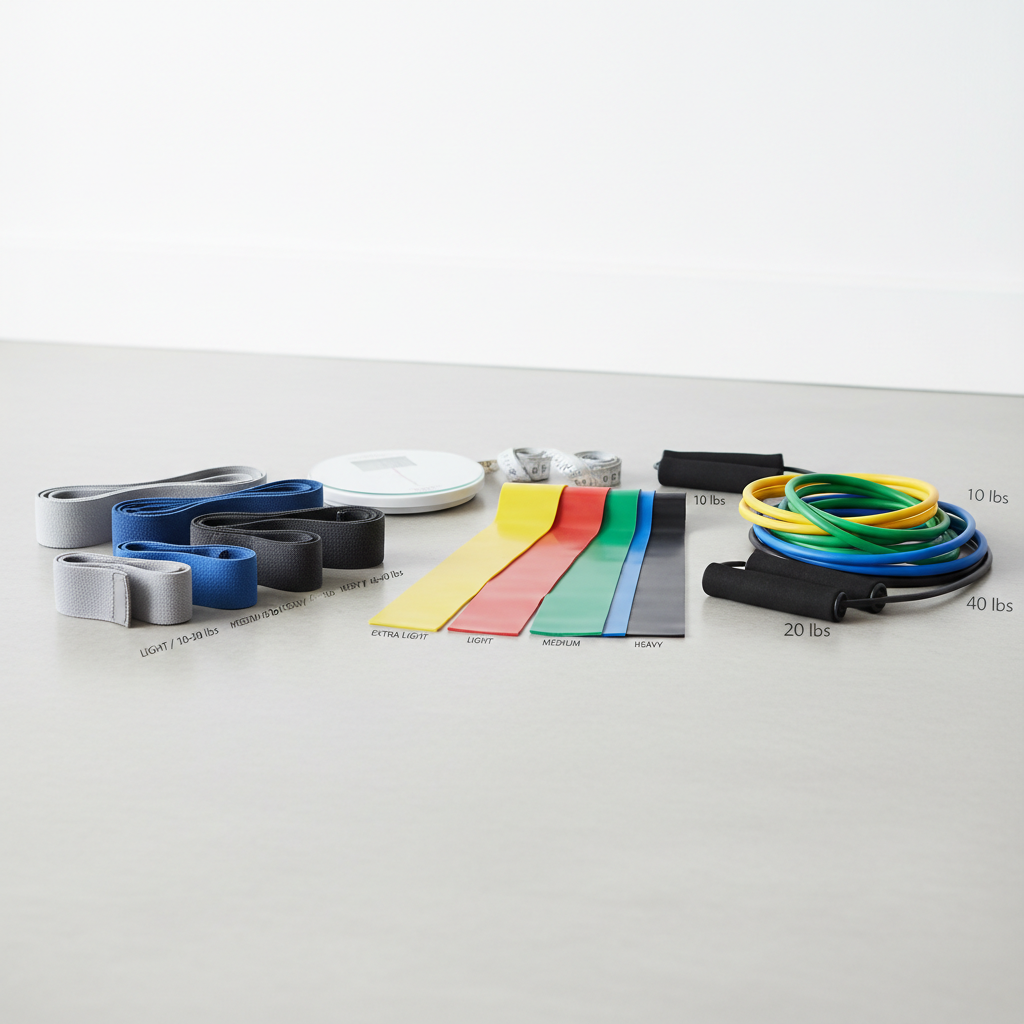
These are probably what most people picture when they hear "resistance band." They're long, continuous loops of heavy-duty rubber, usually flat. * **Description:** These come in varying widths and thicknesses, which directly correlate with their resistance level. The wider and thicker the band, the greater the resistance. They're often colour-coded, though colours can vary between brands. * **Common Uses:** * **Strength Training:** Adding resistance to squats, deadlifts, bench presses (by looping over a barbell), good mornings. * **Assisted Pull-ups/Dips:** Looping around a pull-up bar and your knee/foot to reduce your bodyweight, making the exercise easier. * **Stretching & Mobility:** Assisting deeper stretches. * **Powerlifting:** Often used for "accommodating resistance" in powerlifting to make lifts harder at the top. * **Materials:** Primarily natural latex rubber. Some newer versions are made from fabric, which we'll discuss later. * **Resistance Levels:** Ranging from very light (e.g., 5-15 lbs equivalent) to extremely heavy (e.g., 150-200 lbs equivalent). * **Pros:** * Extremely versatile for compound movements and assistance exercises. * Excellent for progressive overload. * Relatively compact for their resistance. * Can be anchored easily. * **Cons:** * Can snap if misused or overstretched, especially cheaper latex ones. * Can roll up or pinch skin during some exercises. * Latex allergy sufferers need to be careful. * Heavier bands can be cumbersome to use for isolation work. * **Example Prices (UK):** A single medium-heavy loop band might cost £10-£25. A set of 3-5 varying resistance bands typically ranges from £25-£60.Mini Loop Bands / Glute Bands
Smaller, shorter loops, often referred to specifically as "glute bands" because of their popularity for lower body workouts. * **Description:** These are smaller circumference loops, designed to fit around your thighs, ankles, or feet. They're typically much shorter and wider than power bands. They also come in latex and increasingly, fabric versions. * **Common Uses:** * **Glute Activation:** Essential for warming up and engaging glute muscles before leg workouts. * **Targeted Lower Body:** Hip abductions, glute bridges, monster walks, clam shells, lateral walks. * **Rehabilitation:** Excellent for hip and knee stability exercises. * **Materials:** Natural latex rubber or fabric (often a polyester/cotton blend with rubber grips woven in). * **Resistance Levels:** Usually lighter than power bands, ranging from extra light to extra heavy. The resistance is felt much more intensely due to the shorter stretch. * **Pros:** * Perfect for glute and hip activation. * Fabric versions are super comfortable and don't roll or pinch. * Small and highly portable. * Excellent for pre-hab and rehab. * **Cons:** * Latex versions can roll up or snap. * Limited use for upper body or full-body compound movements. * Fabric versions can be pricier. * **Example Prices (UK):** A set of 3-5 latex mini loops might be £8-£20. A set of 3-5 fabric mini loops could be £15-£35.Tube Bands with Handles
These are long, hollow rubber tubes with handles attached at each end, often with a carabiner clip system. * **Description:** Unlike loop bands, these are open-ended, allowing for a broader range of movements mimicking dumbbell and cable machine exercises. The handles provide a comfortable grip. Many sets come with additional accessories like door anchors and ankle straps. * **Common Uses:** * **Upper Body:** Chest press, rows, bicep curls, tricep extensions, shoulder press, lateral raises. * **Full Body:** Squats (by standing on the band), lunges. * **Travel Workouts:** Excellent for hotel room workouts. * **Materials:** Often natural latex, but also TPE compounds for those with latex sensitivities.Progressive Overload with Bands
Unlike dumbbells with fixed increments, resistance bands provide continuous tension that increases as you stretch the band further. This unique property means you can create hundreds of different resistance levels by simply adjusting your anchor point or using multiple bands together. For beginners, start with a light band and focus on perfect form before progressing to heavier resistances.
Combining Bands with Other Equipment
Resistance bands work exceptionally well when combined with other home gym equipment. Pair them with adjustable dumbbells for a comprehensive strength setup, or use bands as an assistance tool during pull-up training. Many find that adding a simple pull-up bar transforms band training from supplemental to fully comprehensive.
One factor that often gets overlooked is how resistance bands interact with your existing training programme. If you already lift weights, bands work brilliantly for warm-up activation exercises and for adding variable resistance to compound movements like squats and bench press. The resistance increases as the band stretches, which challenges your muscles differently than free weights alone and can help break through training plateaus.