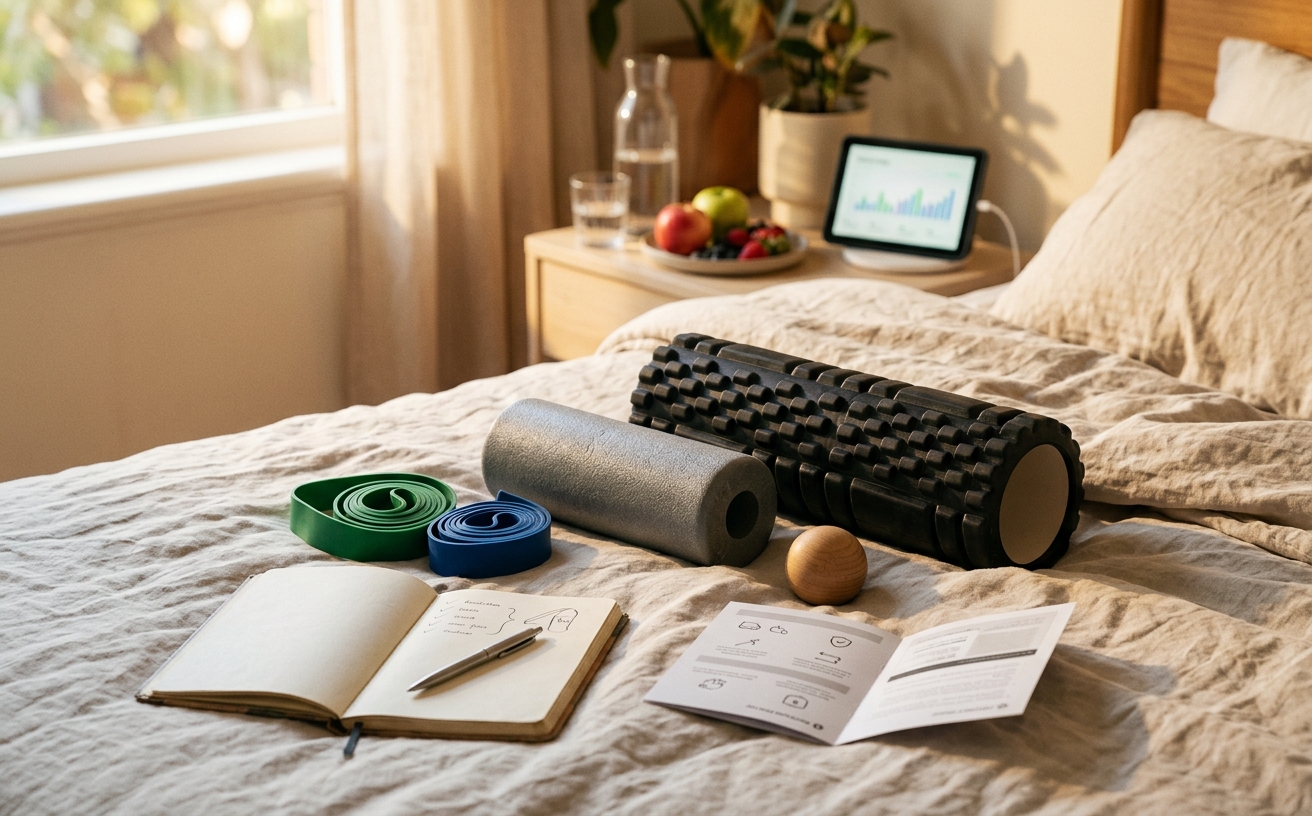
The life constraint comes first; the product claim stays on probation.
If you have spent any time in a gym, a local physio clinic, or even just browsing fitness equipment online, you have likely encountered the foam roller. It usually sits in the corner of the living room, viewed with a mix of guilt and dread. For years, the prevailing advice was that spending ten minutes grimacing on a dense cylinder of foam was a mandatory part of recovery, necessary to iron out tight muscles after a run along the Yarra trails or a heavy gym session.
But if you are wondering whether foam rolling is actually useful or just a form of self-inflicted pain, you are asking the right question. The short answer is yes, foam rollers can be a highly effective tool for temporary mobility and recovery, but they do not work the way we used to think they did. You are not physically breaking down scar tissue or lengthening your IT band. Instead, you are communicating with your nervous system.
Understanding this shift in perspective changes everything about how you should choose a foam roller and how you should use it. Rather than looking for the hardest, most aggressive tool available to force your muscles into submission, the goal is to find a density and texture that allows your body to relax. Here is a practical look at the reality of foam rolling, how to buy the right one for your space and tolerance, and how to avoid the common mistakes that make the practice miserable.
The Reality of Foam Rolling: What It Actually Does
For a long time, the fitness industry promoted the idea of myofascial release. The theory was that fascia, the connective tissue wrapping around our muscles, gets glued down and restricted, and that applying heavy pressure with a foam roller physically breaks up these adhesions. We now know that human fascia is incredibly tough. It requires massive amounts of force to physically deform it—far more force than your body weight on a piece of foam can generate.
So, why do you feel looser after foam rolling? The current understanding points to neurology, not structural mechanics. When you apply slow, sustained pressure to a muscle, the sensory receptors in your skin and muscle tissue send signals to your brain. If the pressure is tolerable, your brain responds by down-regulating the tension in that specific area. It is essentially a neurological conversation that temporarily reduces your perception of tightness and increases your short-term range of motion.
This means foam rolling is excellent for a warm-up, giving you a temporary window of increased mobility before you start moving. It is also useful for winding down, helping to shift your nervous system into a parasympathetic (rest and digest) state before sleep. However, because the effect is largely neurological and temporary, consistency matters more than intensity. If you are rolling so hard that you are tensing up and holding your breath, you are sending a threat signal to your brain, which entirely defeats the purpose.
When to Skip the Roller (Safety First)
While foam rolling is generally safe for everyday muscle stiffness, it is not a cure-all, and there are specific times when it can cause harm. Do not use a foam roller as a substitute for professional medical assessment if you are dealing with persistent pain.
- Acute Injuries: Never roll directly over a fresh muscle tear, a sprained joint, or severe bruising. Applying heavy pressure to damaged tissue will only increase inflammation and delay healing.
- Chronic Conditions: If you have osteoporosis, fibromyalgia, deep vein thrombosis, or peripheral neuropathy, foam rolling may be contraindicated. Always consult your doctor or a qualified physiotherapist before adding pressure-based recovery tools to your routine.
- Pregnancy: During pregnancy, the hormone relaxin makes your joints and ligaments more lax and unstable. Aggressive rolling, especially around the lower back and pelvis, can cause issues. Speak to a pelvic health physiotherapist for appropriate mobility exercises.
- Mental Health and Compulsive Routines: Recovery tools can sometimes become tied to rigid, compulsive exercise behaviors. If missing a foam rolling session causes severe anxiety, or if you feel you must endure extreme pain to earn your recovery, it may be worth discussing these patterns with a healthcare professional or a mental health clinician.
Materials and Density: What to Look For
If you have decided a foam roller fits your routine, the next step is navigating the materials. The density of the foam dictates how intense the pressure will be. If you buy a roller that is too firm, you likely will not use it. If you buy one that is too soft, it may deform and lose its shape quickly.
Expanded Polypropylene (EPP) Foam
EPP foam rollers are usually black or speckled and look like tightly packed foam beads. They are lightweight, inexpensive, and very firm. You can often find them for under twenty dollars. The trade-off is durability. Over time, with heavy daily use, EPP foam can compress, warp, or bow in the middle. However, for a beginner looking for a firm, no-fuss option without spending much money, an EPP roller is a reasonable starting point.
Ethylene-Vinyl Acetate (EVA) Foam
EVA foam is a higher-quality material that feels slightly rubbery or squishy to the touch, though the core remains firm. These rollers are highly durable, resist moisture (making them easy to wipe down), and hold their shape for years. They are more expensive than EPP rollers, but the slight give in the EVA material makes them much more forgiving on the nervous system. If you plan to roll regularly, an EVA roller is usually the better long-term investment.
Shapes and Sizes: A Practical Breakdown
Foam rollers come in various lengths and surface textures. Choosing the right one depends heavily on your available floor space and your specific mobility goals.
The Length: 90cm vs. 30cm
A full-length 90cm roller is the gold standard for home use. Its primary advantage is that you can lie on it vertically, aligning it from your tailbone up to your head. This position allows your shoulders to drop open, providing a gentle, passive stretch for the chest and front of the shoulders—a highly practical movement for anyone who spends hours hunched over a desk. The downside is that a 90cm roller takes up significant space in a living room or bedroom.
Shorter rollers, typically 30cm to 45cm, are highly portable. They easily fit into a gym bag or a closet. They are perfectly fine for rolling out calves, hamstrings, and quads one leg at a time. However, you cannot lie on them vertically, and balancing on them can be slightly more awkward.
Smooth vs. Textured Rollers
Smooth rollers provide broad, even displacement of pressure. They are predictable and generally the best choice for the vast majority of people.
Textured rollers, often featuring grids, bumps, or ridges, are designed to mimic the thumbs or elbows of a massage therapist. In practice, these can be excessively aggressive. Because the surface area of the bumps is smaller, the pressure is much sharper. For many people, this sharp pressure triggers muscle guarding, where the body instinctively tenses up to protect itself from the pain. Unless you are highly experienced with foam rolling and specifically prefer a very deep, targeted pressure, stick to a smooth roller.
Vibrating Rollers
Vibrating rollers feature an internal motor with various speed settings. The theory is that vibration adds another layer of sensory input, further relaxing the nervous system and distracting the brain from the discomfort of the pressure. While many users report that vibration makes rolling more comfortable, these devices are significantly more expensive and require regular charging. They are a luxury, not a necessity, for basic recovery.
Common Mistakes That Cause Unnecessary Pain
A foam roller is only as useful as your technique. Many people abandon rolling because they misuse the tool, resulting in bruising and frustration. Here are the most common practical errors to avoid.
- Rolling the Lower Back: You should generally avoid rolling directly across your lumbar spine. Unlike your upper back, which is protected by the rib cage and shoulder blades, your lower back has no bony structures to protect the spine from the pressure of the roller. It can cause the spinal muscles to spasm. If your lower back is tight, focus on rolling your glutes and hips instead.
- Attacking the IT Band: The Iliotibial (IT) band is a thick, fibrous band of connective tissue running down the outside of your thigh. It is supposed to be tight to stabilize your knee. Rolling directly on the side of your leg compresses this tissue against the femur, which is excruciatingly painful and does nothing to loosen the band. Instead, roll the muscles that attach to the IT band: the glutes, the tensor fasciae latae (TFL) at the front of the hip, and the quadriceps.
- Moving Too Fast: Rolling back and forth rapidly does not give your nervous system time to adapt to the pressure. The movement should be slow and deliberate, moving only an inch or two per second. When you find a tender spot, pause and breathe into it for twenty to thirty seconds.
- Holding Your Breath: As mentioned earlier, holding your breath is a stress response. If the pressure is so intense that you cannot maintain a slow, steady breathing pattern, you need to shift your weight off the roller slightly or switch to a softer foam density.
Frequently Asked Questions
Should I foam roll before or after a workout?
Both applications have distinct benefits. Using a roller before a workout helps increase blood flow and provides a temporary increase in joint range of motion, making it a great addition to a dynamic warm-up. Using it after a workout, or in the evening, can help decrease the perception of muscle soreness and promote relaxation by shifting the body into a calmer state.
How long should I spend on a foam roller?
More is not always better. Spending 90 seconds to two minutes per muscle group is generally sufficient to trigger a relaxation response. A full-body routine should only take about ten to fifteen minutes. If you spend forty-five minutes rolling, you are likely just irritating your tissues.
Are massage balls better than foam rollers?
They serve different purposes. A foam roller is excellent for broad, sweeping pressure across large muscle groups like the quads, hamstrings, and lats. Massage balls (like a lacrosse ball or a peanut) are better for targeted pressure in small, specific areas, such as the arches of the feet, the glutes, or between the shoulder blades. Many people find it practical to own one of each.