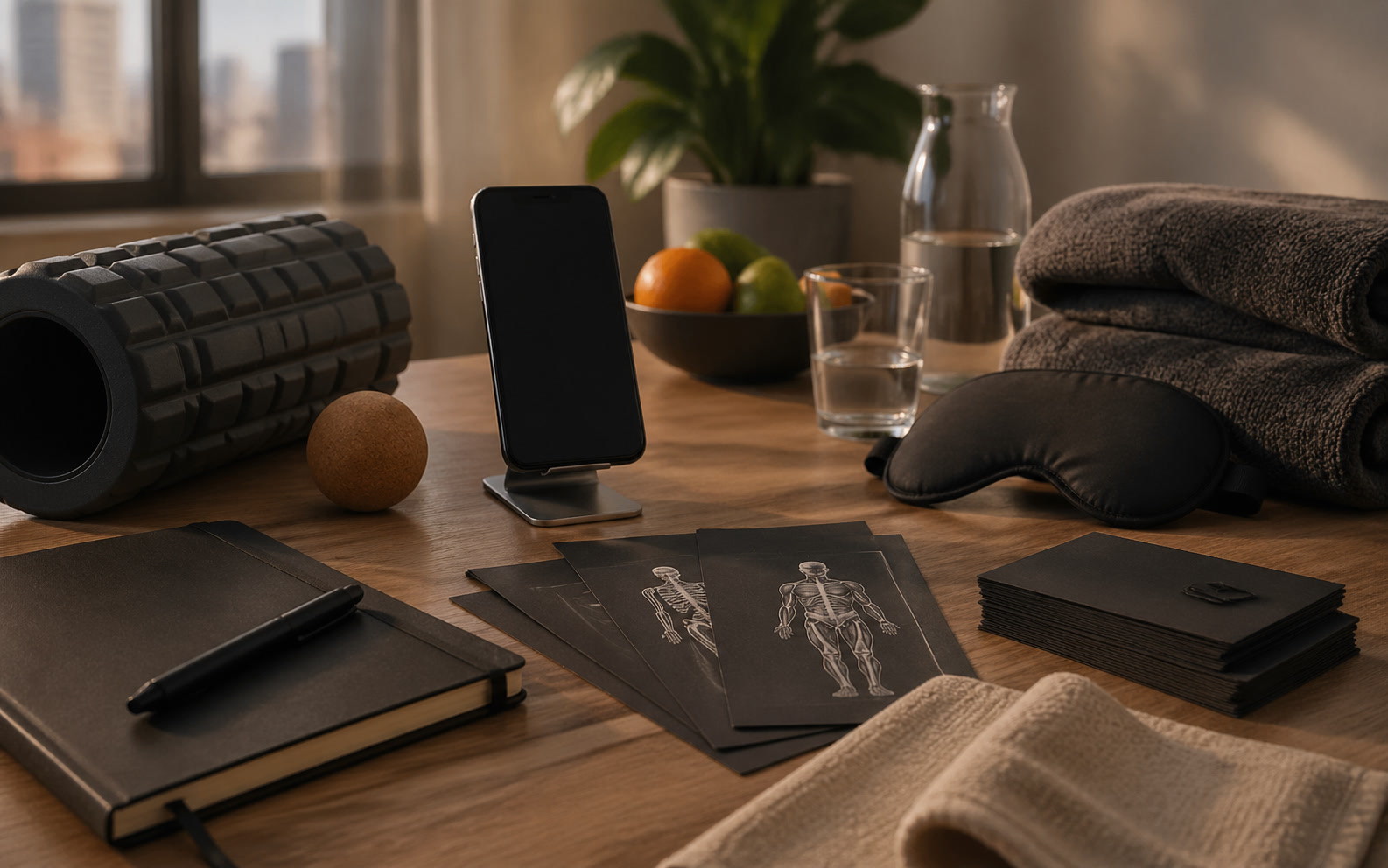
The life constraint comes first; the product claim stays on probation.
We often reach the end of a long day feeling physically restricted. Whether it is stiffness from sitting at a desk or residual tightness from a heavy training session, the immediate impulse is to find a straightforward fix. Flexibility and mobility apps have flooded the digital marketplace, offering daily routines, streak counters, and the visual promise of touching your toes within a few weeks. But do these digital platforms actually deliver meaningful changes to your tissue tolerance and joint health?
The reality is that stretching apps are highly effective at building basic habits and reducing decision fatigue. If your primary barrier to mobility work is that you simply do not know what movements to do, a daily notification and a guided video will help. However, if you are relying on an algorithm to rehabilitate a tight lower back, correct a postural imbalance, or navigate a complex joint issue, the capacity of an app is severely limited. They cannot assess your individual anatomical constraints, nor can they tell when you are pushing a joint past its safe structural limit.
What Digital Flexibility Programmes Actually Do Well
To evaluate these platforms fairly, we have to look at the specific mechanical and behavioral benefits they provide. When used correctly, a well-designed flexibility app offers several distinct advantages over trying to stretch from memory.
Pacing and Time Under Tension
Most people are notoriously bad at estimating time while stretching. You might hold a hamstring stretch for eight seconds, feel uncomfortable, and assume a full thirty seconds has passed. Apps force you to sit in the discomfort safely for the required duration. By providing audio cues and visual timers, they ensure your tissues actually receive the sustained load necessary to signal the nervous system to relax.
Structured Progressive Overload
Flexibility requires progressive loading, much like strength training. High-quality apps organize their routines so that you are not simply repeating the exact same five stretches every day. They introduce subtle variations, gradually increasing the complexity of the movements or the duration of the holds, which helps prevent plateaus in your mobility progress.
Visual Regressions
The most responsible platforms on the market do not just show one incredibly flexible instructor performing a movement. They utilize split screens to demonstrate beginner, intermediate, and advanced variations simultaneously. This visual permission to take the easier option is crucial for preventing overexertion in users who are just beginning their mobility practice.
The Blind Spots: Where Screen-Based Stretching Fails
Despite their convenience, relying solely on a screen for physical adaptation introduces significant blind spots. Stretching is not simply a mechanical process of pulling a muscle like a rubber band; it is a neurological negotiation. You are trying to convince your nervous system that a new range of motion is safe.
The Illusion of AI Camera Feedback
Many modern apps promote camera-based feedback, claiming the algorithm can correct your form in real-time. While these systems can map gross joint angles—such as whether your knee is bent or straight—they cannot feel tissue tension. An algorithm does not know if your failure to reach the floor is due to tight hamstrings, a rigid sciatic nerve, or bone-on-bone impingement in your hip socket. Relying on a camera for form correction can sometimes encourage users to force their bodies into shapes that their specific anatomy does not support.
Gamification and Tissue Damage
Streaks, badges, and leaderboards work well for language learning, but they introduce physical risks when applied to flexibility. Gamifying mobility often encourages people to push through pain to maintain a daily streak or achieve a deeper stretch badge. Flexibility adaptations happen slowly. Forcing a stretch when your body is fatigued or inflamed simply to satisfy an app's daily requirement can lead to micro-tears and prolonged stiffness.
Passive Stretching vs. Active Control
A major limitation of many popular stretching apps is their heavy reliance on passive stretching. This involves using gravity or external force to hold a position. While passive stretching feels good and can temporarily increase range of motion, it does not build strength in that new range. Without active mobility—using your own muscles to control the joint at its end range—the new flexibility is often temporary and can leave the joint vulnerable to instability.
When to Skip the App and Seek Clinical Guidance
General mobility routines are designed for the average, healthy population. They are not diagnostic tools and cannot replace individualized clinical care. There are several scenarios where downloading a stretching app is not just unhelpful, but potentially harmful.
Hypermobility Spectrum Disorders
If you have a hypermobility condition, such as Ehlers-Danlos Syndrome (EDS), your joints already possess excessive range of motion. People with hypermobility often feel constantly tight because their muscles are working overtime to stabilize loose joints. Stretching these overworked muscles can destabilize the joints further. These individuals require targeted stabilization and strength protocols, not flexibility apps.
Pregnancy
During pregnancy, the body produces a hormone called relaxin, which increases joint laxity to prepare for childbirth. Following a generalized stretching app during this time can easily lead to overstretching and pelvic instability. Movement during pregnancy should be guided by professionals who understand these specific hormonal changes.
Acute Injuries and Chronic Pain
A generalized stretching routine is entirely inappropriate for acute injuries such as muscle strains, ligament sprains, or tendon tears. Similarly, using an app to manage chronic, persistent pain without a proper diagnosis can exacerbate the underlying issue.
If you are pregnant, managing a chronic illness, recovering from an injury, or experiencing sharp, localized pain, nerve tingling, or numbness during movement, skip the app store. Consult a physiotherapist or allied health professional for an assessment.
How to Audit a Stretching App During the Free Trial
If you decide to test a flexibility platform, use the initial trial period to evaluate its safety and utility. Rather than just looking at the interface, apply a critical eye to how the programming is structured.
- Does it ask about your physical history? A responsible app should have an onboarding process that asks about previous injuries, current pain points, and baseline activity levels before recommending a routine. If it immediately drops you into an intense program without any screening, proceed with caution.
- Is the pacing realistic? Programs that promise you will achieve the front splits in thirty days are relying on aggressive marketing rather than physiological reality. Tissue adaptation takes months of consistent, patient work. Look for apps that emphasize gradual progress and consistency over rapid transformations.
- Does it distinguish between muscle stretch and nerve tension? A quality mobility program will educate its users. It should explain the difference between a dull, broad ache (a safe muscle stretch) and sharp, shooting pain or tingling (nerve tension). Stretching an irritated nerve is highly counterproductive, and good instructors will warn you to back off if you feel tingling.
- Are strength elements included? Review the exercise library to see if it includes isometric holds, active liftoffs, or end-range strengthening exercises. If the entire library consists only of passive, relaxed holds, the app is only offering half of the mobility equation.
Practical Alternatives to Paid Subscriptions
You do not need a monthly subscription to improve your flexibility. If you want to step away from screens entirely, there are grounded, effective ways to build a mobility habit.
One approach is to time-block ten minutes of floor movement in the evening. Instead of following a specific routine, use this time to explore basic movements like thoracic rotations, hip switches, and gentle forward folds. Use a physical stopwatch rather than a phone to time your holds, aiming for two minutes of total accumulated time per tight muscle group.
Another highly effective alternative is booking a single session with a physiotherapist or exercise physiologist. They can assess your specific mechanical restrictions and provide you with three or four high-yield movements tailored to your body. Practicing those few movements consistently will almost always yield better results than following a generalized app routine of thirty different stretches.
Frequently Asked Questions
Are five minutes of daily stretching enough to see progress?
It depends entirely on your baseline and your goals. Five minutes of daily movement is excellent for maintaining your current range of motion, improving circulation, and reducing the immediate stiffness of a sedentary day. However, if your goal is to make structural changes to your tissue tolerance—such as significantly improving your overhead reach or hip mobility—five minutes is rarely sufficient. Structural adaptation usually requires longer periods of sustained tension and active strengthening.
Should a stretch feel painful?
No. A productive stretch should feel like a mild to moderate discomfort, often described as a dull, broad tension in the belly of the muscle. It should never feel like a sharp, localized pain, and it should never cause tingling or numbness. If you find yourself holding your breath or bracing your body to tolerate the sensation, you have gone too far. The nervous system needs to feel safe to allow the muscle to lengthen; pain triggers a defensive contraction.
Is it better to stretch before or after a workout?
The current consensus in sports science separates mobility into two distinct phases. Before a workout, focus on dynamic movement—taking your joints through their full active range of motion to warm up the tissues and prepare the nervous system for loading. Save static stretching—holding a single position for an extended period—for after the workout or as a separate session entirely, as prolonged static stretching immediately before heavy lifting can temporarily decrease muscle power output.