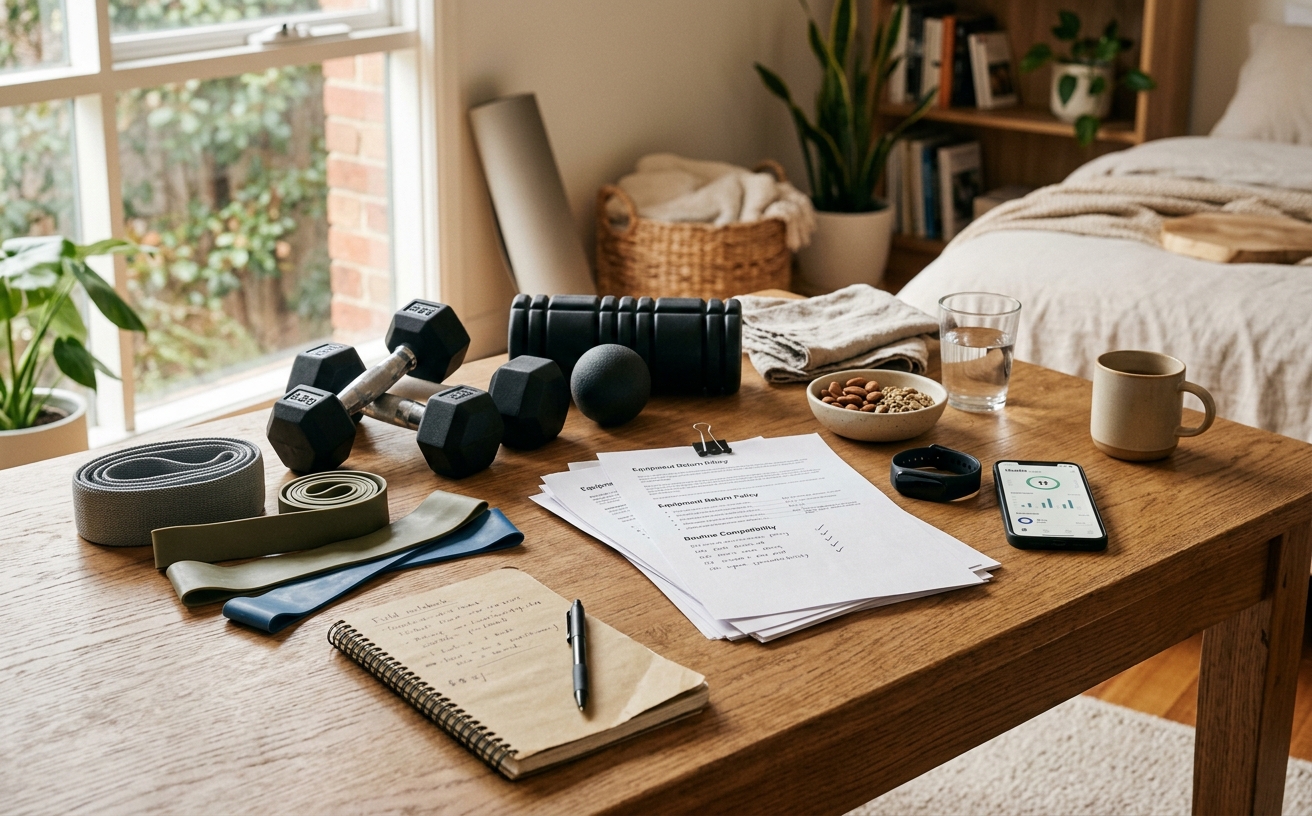
The life constraint comes first; the product claim stays on probation.
Entering the world of strength training often feels like walking into a high-pressure sales environment. Between targeted advertisements for smart mirrors, complex cable systems, and expensive adjustable weights, it is easy to assume that building a baseline of physical strength requires a significant financial investment. For a beginner, the primary goal is simply to introduce the musculoskeletal system to gradual, safely managed resistance. You do not need a fully outfitted commercial gym in your spare room to achieve this.
The fundamental mechanism of building strength is progressive overload—consistently challenging your muscles with slightly more resistance than they are accustomed to handling. Your muscles respond to tension, not to the brand name of the equipment providing it. This equipment check evaluates the practical trade-offs of common beginner strength tools, helping you audit your actual needs based on your budget, available space, and physical baseline, while ignoring the marketing noise surrounding fitness gear.
When to Pause: Medical and Safety Boundaries
Strength training places deliberate stress on your muscles, connective tissues, and cardiovascular system. While this stress is the catalyst for adaptation, it can be harmful if applied incorrectly or under the wrong physical conditions. General equipment advice assumes a baseline of healthy joint function and cardiovascular stability.
You should skip purchasing equipment and instead consult a physiotherapist, exercise physiologist, or general practitioner if you are currently managing chronic joint pain, recovering from musculoskeletal injuries, or experiencing undiagnosed mobility limitations. Individuals with cardiovascular disease, uncontrolled high blood pressure, or a history of severe dizziness upon exertion must seek medical clearance before undertaking any resistance program. If you are pregnant, your center of gravity and joint laxity will change significantly; working with a clinician who specializes in prenatal movement is necessary to adapt your equipment and routine safely. Furthermore, if your interest in strength training is driven by an eating disorder, compulsive exercise habits, or severe mental health distress, please prioritize speaking with a healthcare professional before initiating a new physical regimen.
The Resistance Requirement: What the Evidence Says
From a physiological standpoint, early strength gains in beginners are largely neurological. Before your body builds new muscle tissue, your nervous system simply becomes more efficient at recruiting the muscle fibers you already possess. This phase usually lasts for the first several weeks of a new routine.
Because these early adaptations do not require massive loads, beginners have a wide margin for error regarding equipment choice. Gravity, friction, and elastic tension all serve the same functional purpose in these initial stages. The primary requirement is that the equipment allows you to perform basic human movement patterns—pushing, pulling, squatting, and hinging—safely and with a manageable range of motion.
Evaluating Bodyweight Basics
Your own body is the most accessible tool available. Calisthenics require zero financial output and zero storage space, making them highly appealing for apartment living or tight budgets.
The Trade-offs: Bodyweight training excels at teaching proprioception (awareness of your body in space) and core stability. Movements like push-ups, lunges, and planks are highly effective for beginners. However, bodyweight training has a distinct limitation: pulling movements. Without a pull-up bar or a suspension trainer, it is mechanically difficult to adequately train the muscles of the back and the posterior shoulder. Additionally, as your lower body is naturally very strong, progressing bodyweight squats often requires moving to complex single-leg variations (like pistol squats) which demand high levels of balance and mobility that a beginner may not yet possess.
Resistance Bands: Cost-Effective but Difficult to Track
Tubular or flat latex resistance bands are frequently recommended for home routines. They are inexpensive, easily stored in a drawer, and highly versatile.
The Trade-offs: The primary benefit of bands is their variable resistance profile. As the band stretches, the tension increases, which can be excellent for continuous muscle engagement and joint rehabilitation. However, tracking progressive overload is notoriously difficult with bands. It is nearly impossible to quantify whether you stretched a green band precisely the same distance today as you did last Tuesday. Furthermore, latex degrades over time. Bands must be inspected regularly for micro-tears to prevent them from snapping under tension, which poses a significant safety risk to the eyes and face.
Free Weights: Adjustable vs. Fixed Dumbbells
For those looking to invest in iron, dumbbells are the standard recommendation. They allow for unilateral training (working one side of the body at a time), which helps identify and correct strength imbalances.
Fixed Dumbbells: These are highly durable and allow for quick transitions between exercises. The downside is cost and space. A beginner will quickly outgrow a pair of five-kilogram weights for lower body exercises, necessitating a rack of multiple weights that takes up significant floor space and budget.
Adjustable Dumbbells: These systems use a dial or pin mechanism to select different weights from a single base. They are the most space-efficient option for home training. The trade-off is their physical footprint during use; they can be bulky, making certain movements awkward. They are also fragile compared to fixed weights. Dropping a selectorized adjustable dumbbell can shatter the internal selection mechanism, rendering an expensive piece of equipment useless.
The Machine Advantage for Beginners
While home equipment is convenient, auditing your needs might reveal that a basic gym membership is a safer and more practical investment. Commercial gyms offer selectorized weight machines, which are often unfairly dismissed in favor of free weights.
The Trade-offs: Machines lock you into a fixed plane of motion. For a beginner whose stabilizing muscles are not yet developed, this is a distinct advantage. A leg press or a chest press machine allows you to safely apply heavy resistance to the target muscles without the risk of dropping a weight on yourself or losing your balance. The limitation is that machines do not train the smaller stabilizing muscles as effectively as free weights, but they provide an excellent, safe foundation for initial strength building.
Accessories to Ignore
The fitness industry excels at selling peripheral accessories that beginners simply do not need. When auditing your equipment plan, leave the following items off your list:
- Lifting Belts: Unless you are lifting very heavy loads in barbell squats or deadlifts, a belt is unnecessary. Beginners should focus on learning to brace their core naturally.
- Weightlifting Gloves: While they prevent calluses, gloves often bunch up and artificially thicken the grip of a dumbbell or bar, making it harder to hold onto the weight securely.
- Smart Mirrors and Connected Screens: These devices offer follow-along classes but charge a premium for hardware that quickly becomes obsolete. A standard laptop or phone screen playing a routine is entirely sufficient.
- Specialized Footwear: Unless you are transitioning into competitive Olympic weightlifting, expensive lifting shoes with elevated wooden heels are an unnecessary purchase. Flat-soled sneakers or training in bare feet (if safe in your environment) work perfectly well for baseline strength movements.
Practical Equipment Audit Checklist
Before making any purchase, run through this basic audit to determine what makes sense for your specific situation:
- Assess your space: Do you have a dedicated room, or will this equipment need to slide under a bed or into a closet after every use? If space is tight, prioritize resistance bands or a single pair of adjustable dumbbells.
- Evaluate your budget: Can you afford the equipment you will need three months from now? Beginners gain strength quickly. Buying a single light kettlebell might serve you for two weeks before it becomes too light for lower-body work.
- Define your consistency: Have you maintained a bodyweight routine for at least a month? If not, hold off on purchasing heavy equipment until you have established the habit of setting aside time for movement.
- Check your flooring: If you rent an apartment, dropping heavy iron on floorboards can cause severe damage and noise complaints. If you opt for free weights, you must also budget for thick, high-density rubber mats.
Frequently Asked Questions
Do I need a weight bench for home training?
A bench is useful but not strictly necessary for a beginner. Many pressing movements, such as the dumbbell chest press, can be performed effectively while lying flat on the floor (known as a floor press). This actually provides a safety advantage, as the floor prevents your elbows from traveling too far downward, protecting the shoulder joint while you learn the movement.
Are kettlebells better than dumbbells?
Neither is inherently better; they are simply different tools. Kettlebells have an offset center of gravity, which makes them excellent for dynamic, swinging movements. However, these ballistic movements require strict technique to avoid lower back strain. For slow, controlled strength building, dumbbells are generally easier for a beginner to manage and grip.
How heavy should my first weights be?
This is highly individual and depends entirely on your current physical baseline. A weight that feels challenging for a bicep curl will likely feel far too light for a goblet squat. This discrepancy is why adjustable systems or access to a gym's full range of weights is usually more practical than attempting to guess the "perfect" single weight to buy for your home.