The life constraint comes first; the product claim stays on probation.
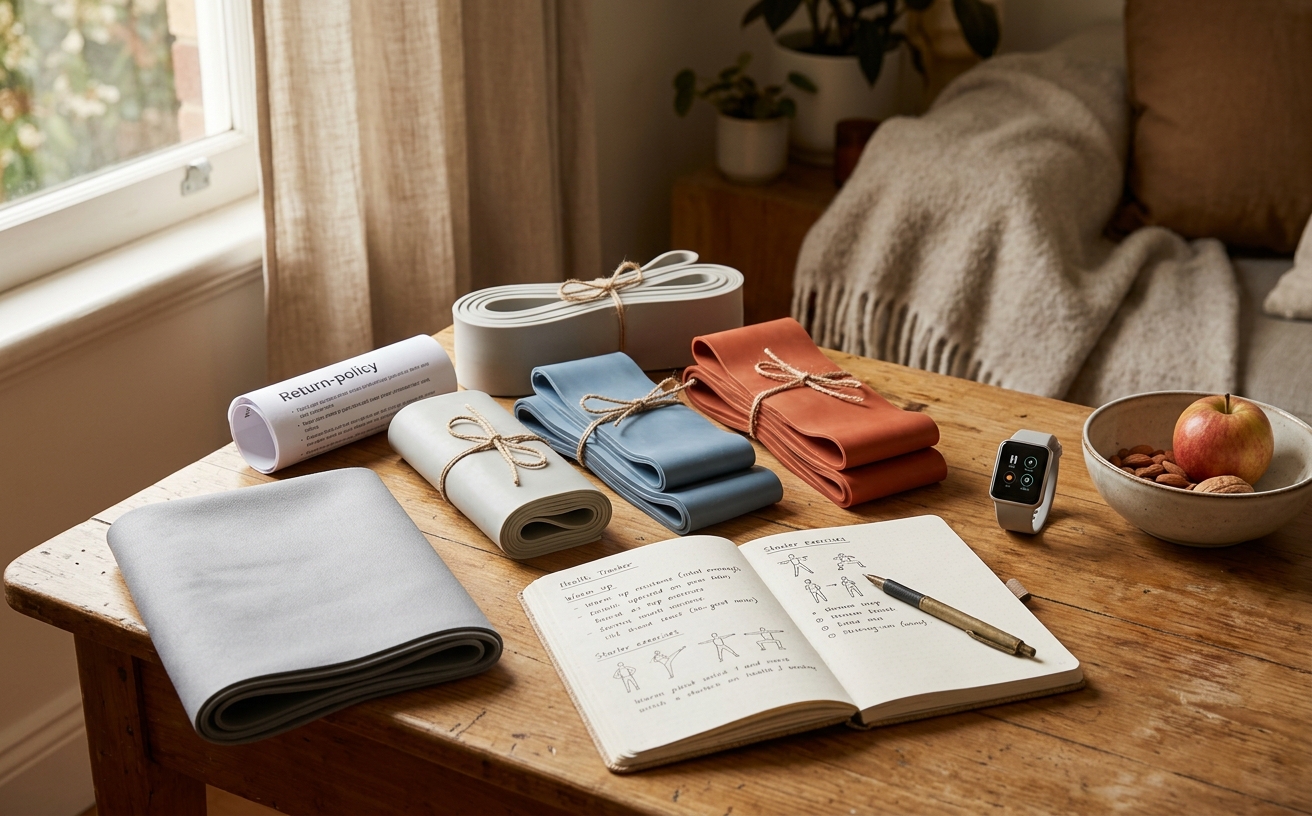
Resistance bands often sit unused in bottom drawers, purchased with good intentions but abandoned due to a lack of clear direction. They offer a highly accessible entry point to strength training, particularly useful when unpredictable weather makes leaving the house feel like a chore. The appeal is obvious: they are inexpensive, portable, and require minimal storage space. However, the reality of training with elastic tension is that it demands more focus on form and control than traditional free weights.
Using a resistance band effectively requires understanding variable resistance. Unlike a ten-kilogram dumbbell, which weighs ten kilograms throughout the entire range of motion, a band provides more resistance the further it is stretched. This unique strength curve is excellent for joint health, as the load is lightest when the joint is in its most vulnerable, fully flexed position. Yet, it also means that without deliberate pacing, the band will simply snap back to its resting state, removing the muscular engagement required to build baseline strength.
Safety Protocols and Who Should Skip This Routine
Before attaching a band to a doorframe or stepping on it, it is necessary to establish safety boundaries. Resistance bands are safe when used correctly, but they store potential energy. An equipment failure or a slipped anchor can result in the band snapping back with significant force.
This routine is designed for general fitness and baseline conditioning. It is not medical advice. You should skip this routine and consult a qualified clinician or physiotherapist if any of the following apply to you:
- Acute joint injuries: If you are currently managing a torn rotator cuff, severe tennis elbow, or a recent knee sprain, a band is not a substitute for clinical rehabilitation.
- Unmanaged hypertension: Isometric holds and heavy resistance training can cause temporary spikes in blood pressure. Clear any new resistance routine with your doctor if you have cardiovascular concerns.
- Pregnancy: Changes in balance, joint laxity (due to the hormone relaxin), and core pressure mechanics mean that standard routines may need modification. Consult a professional for a tailored approach.
- Severe balance or mobility issues: If you are at a high risk of falling, exercises that require standing on an elastic band introduce an unnecessary tripping hazard.
- Post-operative recovery: Never use resistance training to rush recovery from surgery unless explicitly directed by your surgical or physical therapy team.
For those cleared for general exercise, safety also extends to your equipment. Inspect your bands for micro-tears, discoloration, or brittle spots before every session. A small nick in the rubber will quickly become a complete snap under tension. Always wear closed-toe athletic shoes when stepping on a band; socks or bare feet offer no friction, increasing the risk of the band rolling up and snapping against your legs.
Equipment Setup: Choosing Your Bands and Anchors
For this routine, we focus on continuous loop bands (often called pull-up assist bands) rather than tube bands with plastic handles. Loop bands are more versatile, generally more durable, and allow you to easily adjust tension by changing your grip position.
You will need two or three bands of varying thicknesses (for example, a light, medium, and heavy option) and a heavy-duty door anchor. A proper door anchor is a thick nylon strap with a foam or plastic stopper at one end. Never loop a band around a door handle or a towel rack. These fixtures are not designed to bear lateral weight and will break, potentially causing injury.
When using a door anchor, always place it on the hinge side of the door, and ensure the door pulls away from you, not toward you. Lock the door if possible, or inform your household members that you are training so no one opens the door unexpectedly.
The Foundational Resistance Routine
This sequence targets major muscle groups to improve posture, core stability, and baseline strength. Perform this circuit two to three times per week, allowing at least one full day of rest between sessions. Aim for two to three sets of 10 to 15 repetitions for each movement.
1. The Anchored Row (Posture and Upper Back)
Many daily activities pull our shoulders forward. The anchored row counteracts this by targeting the rhomboids and latissimus dorsi.
- Secure your door anchor at chest height and loop a medium-tension band through it.
- Stand facing the door, holding one end of the loop in each hand. Step back until there is slight tension in the band when your arms are fully extended.
- Adopt an athletic stance: feet shoulder-width apart, knees slightly bent, core engaged.
- Pull the band toward your lower ribs, driving your elbows straight back. Squeeze your shoulder blades together at the peak of the movement.
- Slowly release the tension over three seconds, returning to the starting position without letting the band pull you forward.
2. The Banded Deadlift (Glutes and Hamstrings)
This movement teaches the hip hinge, a fundamental human movement pattern essential for picking objects off the floor safely.
- Lay a heavy-tension band flat on the floor. Step onto the center of the band with both feet, keeping them roughly hip-width apart.
- Squat down and grab the looped ends of the band. Your grip should be firm.
- Keep your chest up, your back straight, and your shoulders pulled back. Your hips should be lower than your shoulders, but higher than your knees.
- Drive through your heels and stand up tall, extending your hips and knees simultaneously. Keep your arms straight; your hands are simply hooks holding the band.
- At the top, squeeze your glutes gently. Do not lean backward.
- Push your hips back and slowly lower to the starting position, maintaining tension in your hamstrings.
3. The Pallof Press (Core Stability)
Instead of crunches, which can aggravate the lower back, the Pallof press trains the core to resist rotation, which is its primary functional purpose.
- Secure the anchor at chest height with a light-tension band.
- Stand sideways to the door. Grab the band with both hands and bring it to the center of your chest. Step away from the door until you feel the band trying to pull your torso toward the anchor.
- Brace your core, as if preparing for a light punch to the stomach.
- Slowly press the band straight out in front of you. As your arms extend, the rotational pull will feel much stronger.
- Hold the fully extended position for two seconds, resisting the urge to twist.
- Slowly return your hands to your chest. Complete all repetitions on one side before facing the opposite direction to train the other side.
4. The Standing Chest Press (Pectorals and Shoulders)
This provides a standing alternative to the push-up, allowing you to easily scale the difficulty based on your current strength level.
- Secure the anchor at chest height using a light or medium band.
- Stand facing away from the door. Hold one end of the loop in each hand, bringing the band over your shoulders or under your armpits (whichever is more comfortable and prevents chafing).
- Step forward into a staggered stance (one foot in front of the other for stability) until the band is taut.
- Press your hands straight out in front of your chest, extending your elbows fully.
- Pause briefly, then control the return phase, taking three seconds to bring your hands back to the starting position.
Progression Tactics Without Buying More Gear
One of the limitations of variable resistance is that you cannot simply add a precise 2.5-kilogram plate to a barbell to force adaptation. However, you can manipulate other variables to ensure you continue building strength without immediately purchasing heavier bands.
First, alter your tempo. If a set of 15 rows feels too easy, slow down the eccentric (lengthening) phase. Taking four or five seconds to release the band will significantly increase the time your muscles spend under tension, creating a stronger stimulus for growth.
Second, adjust your grip or physical distance. Stepping just half a meter further away from the door anchor immediately increases the baseline tension of the exercise. For movements where you step on the band, widening your stance will stretch the band further, increasing the resistance.
Finally, incorporate isometric pauses. Holding the most difficult part of the movement (such as the fully contracted position of a row or the extended phase of the Pallof press) for three to five seconds per repetition will quickly humble even an experienced trainee.
Common Form Errors to Correct Early
Training independently at home means you lack a coach to correct your posture. Paying attention to physical feedback is vital. The most frequent error is allowing the band to dictate the pace. If you pull the band back in one second and let it snap your arms forward in half a second, you are missing half the benefit of the exercise while unnecessarily stressing your joints. The return phase should always take longer than the pulling or pushing phase.
Another common mistake is allowing slack in the band at the beginning of a repetition. If the first quarter of your movement feels entirely weightless, you are standing too close to the anchor point or gripping the band too loosely. There should be a mild, persistent tension even in the resting position.
Frequently Asked Questions
How long do resistance bands last?
Rubber degrades over time, especially when exposed to ultraviolet light, extreme heat, or sharp edges. With regular use, a high-quality latex loop band will typically last one to two years. Store them in a cool, dark place, away from direct sunlight and heating vents. If you notice the material becoming sticky, dry, or developing small fissures, it is time to replace them.
Will resistance bands build muscle like weights do?
Muscles do not know the difference between the gravitational pull of an iron dumbbell and the elastic tension of a rubber band; they only respond to mechanical stress and progressive overload. While bands are highly effective for building baseline muscle, improving endurance, and supporting joint stability, they do have a ceiling. If your goal is to develop maximal absolute strength or powerlifting metrics, bands will eventually need to be supplemented with heavy free weights.
How often should I perform this routine?
Consistency matters more than intensity for beginners. Completing this routine two to three times a week is sufficient. Muscles require adequate recovery time to repair and adapt to the stress of exercise. If you experience severe delayed onset muscle soreness (DOMS) that impairs your daily movement, reduce the tension or the number of sets in your next session.