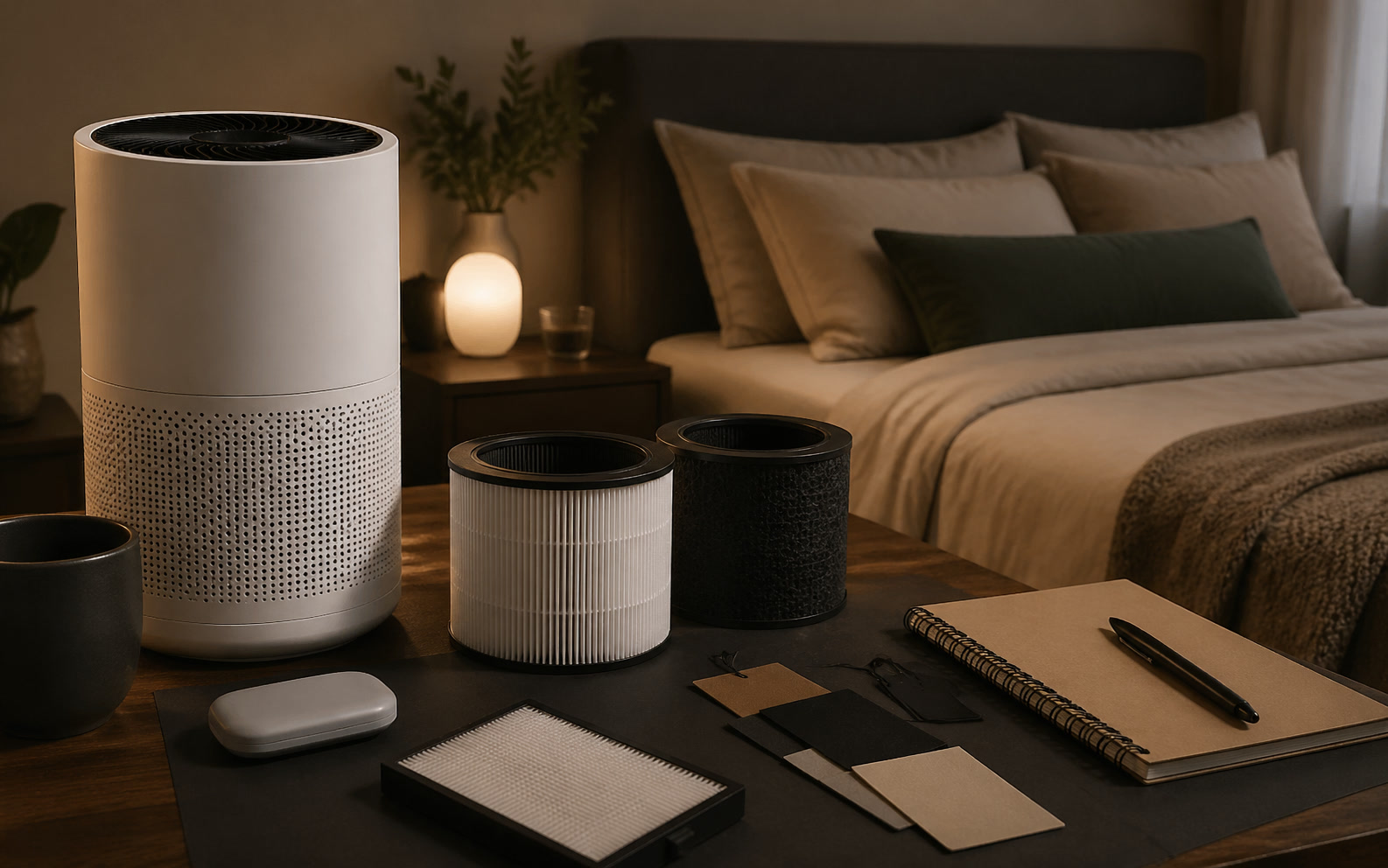
The life constraint comes first; the product claim stays on probation.
Most of us spend seven to eight hours a night breathing the air in our bedrooms. When Melbourne pollen counts spike in spring, or when urban dust and seasonal smoke settle over the suburbs, a bedroom air purifier becomes a highly practical addition to your evening routine. Finding the right unit requires looking past marketing claims and focusing entirely on functional specifications.
A reliable bedroom air purifier needs a True HEPA filter to capture fine particles, a Clean Air Delivery Rate appropriately sized for your specific floor plan, and sleep-oriented design details. If an appliance keeps you awake with mechanical whining or bright display lights, its filtration capabilities become irrelevant. The goal is to find a machine that cleans the air quietly in the background without introducing new disruptions to your rest.
When to Seek Clinical Advice and Who Should Skip This
Before reviewing appliance specifications, we need to establish clear medical boundaries. The information provided here is for general household guidance only and does not constitute medical advice.
An air purifier is a supplementary consumer appliance, not a medical device. You should skip buying an air purifier as a primary solution—and instead consult a medical professional—if you experience the following:
- Severe or chronic respiratory illness: Individuals with diagnosed conditions like severe asthma, COPD, or emphysema must follow their prescribed management plans. Do not rely on an air purifier to replace inhalers, medications, or professional medical interventions.
- Sudden breathing difficulties: Acute shortness of breath, wheezing, or chest tightness requires immediate emergency medical attention.
- Pregnancy-related symptoms: Pregnant individuals experiencing new or worsening allergies, shortness of breath, or sleep disruptions should consult their obstetrician or GP before attempting to manage symptoms with environmental changes alone.
- Sleep apnea: Air purifiers filter particles; they do not treat obstructive sleep apnea, chronic snoring, or structural airway issues. If you suspect a sleep disorder, speak to a doctor about a sleep study.
The Core Specifications: What Actually Cleans the Air
When selecting a unit for the bedroom, the primary focus must be on the physical filtration system. There are two main metrics to evaluate: the filter type and the volume of air the machine can move.
True HEPA Filtration
The standard for residential air purification is the High-Efficiency Particulate Air (HEPA) filter. You want to look specifically for the term True HEPA (often graded as H13). This certification means the filter captures at least 99.97 percent of airborne particles down to 0.3 microns in size. This includes dust mites, pollen, pet dander, and fine smoke particles.
Be highly skeptical of units marketed with terms like HEPA-type, HEPA-like, or HEPA-style. These are unregulated marketing terms for filters that do not meet the strict efficiency standards of True HEPA and will allow smaller, more irritating particles to pass straight back into your bedroom.
Clean Air Delivery Rate (CADR)
The CADR indicates how much filtered air the purifier pushes out, usually measured in cubic metres per hour. Buying a purifier with a high-quality filter is useless if the fan is too weak to circulate the air in your room.
To find the right size, measure your bedroom. Manufacturers typically list a recommended room size for their units. A highly practical approach for the bedroom is to buy a unit rated for a room slightly larger than yours. Over-sizing the unit slightly means you can run the purifier on a lower, quieter fan speed while still achieving four to five total air changes per hour. If you buy a unit exactly rated for your small room, you will likely have to run it on its maximum, loudest setting to get the promised results.
Carbon Filters for Odours
Many units include an activated carbon layer to trap volatile organic compounds (VOCs) and odours. While helpful for mild household smells, the thin carbon sheets found in most standard bedroom purifiers saturate quickly. If your primary issue is heavy smoke odours or chemical off-gassing, you would need a specialized unit with several kilograms of pelletized carbon. For standard bedroom dust and pollen, a basic carbon pre-filter is adequate, but manage your expectations regarding its odour-eliminating lifespan.
Bedroom-Specific Features to Check
A machine that works perfectly in a noisy, brightly lit living room can be entirely unsuitable for a bedroom. When evaluating a unit for sleep environments, you must scrutinize the sensory output.
Noise Levels and Fan Quality
Air purifiers generate noise through airflow and motor operation. Check the decibel (dB) ratings for the unit's lowest and highest settings. For a bedroom, the lowest setting should ideally sit between 20dB and 30dB, which is roughly equivalent to a quiet whisper or rustling leaves.
Pay attention to the type of noise. A steady, low-frequency hum can act as pleasant white noise, masking street sounds or household creaks. However, a high-pitched mechanical whine or a rattling casing will disrupt sleep even at low volumes. Reading consumer reviews specifically focused on motor noise can save you from purchasing a grating appliance.
Display Lights and Sleep Modes
Light pollution is a major issue with modern appliances. A bright blue or green LED indicating air quality might look reassuring in a store, but in a dark bedroom, it acts like a spotlight. Exposure to blue light at night can suppress melatonin production and interfere with your circadian rhythm.
Look for purifiers that feature a dedicated sleep mode. A true sleep mode should not only drop the fan to its quietest setting but also completely turn off all display lights. If a unit only dims the lights rather than extinguishing them, you will likely end up covering the control panel with electrical tape—a frustrating workaround for a brand new appliance.
Airflow Direction
Consider where the clean air exits the machine. Most tower units blow air straight up toward the ceiling, which is generally ideal for a bedroom as it circulates air without creating a direct breeze. Units that blow air out the front can create cold drafts. If placed near your bed, a constant draft across your face or shoulders can cause discomfort and disrupt your rest.
The Hidden Cost: Filter Replacements
When you buy an air purifier, you are essentially buying a subscription to its filters. The upfront cost of the machine is only one part of the equation.
Before committing to a brand, check the price and availability of replacement filters. True HEPA filters typically need replacing every six to twelve months, depending on usage and environmental factors like nearby construction or bushfire seasons. Some proprietary filters can cost half as much as the purifier itself. Ensure that the replacement filters are easy to source in Australia, either directly from the manufacturer or through major local retailers. A cheap purifier becomes useless if you cannot find replacement filters a year later.
Placement and Routine Maintenance
To get the most out of your purifier, proper placement and basic upkeep are required.
Where to Put It
Air purifiers need breathing room. Do not jam the unit into a tight corner, behind a heavy curtain, or right up against the bed frame. Most manufacturers recommend leaving at least 30 to 50 centimetres of clearance on all sides of the intake vents. Placing it across the room from your bed, ideally near the door or a window where air enters the room, helps capture particles before they settle on your sleeping area.
The Maintenance Routine
Most units have a washable or vacuumable pre-filter designed to catch large dust bunnies and pet hair before they clog the expensive HEPA filter. Make it a habit to gently vacuum this pre-filter once a month. This simple routine extends the life of your main filter and keeps the machine running efficiently. Never attempt to wash a True HEPA filter with water, as this will destroy the tightly woven fibres.
Features You Can Safely Ignore
The air purifier market is crowded with unnecessary technological additions. For a bedroom environment, several common features provide little practical benefit and can sometimes introduce new risks.
- Ionizers and Ozone Generators: Avoid these entirely. Ionizers charge particles to make them stick to surfaces, meaning the dust ends up on your walls and bedding rather than in the filter. More importantly, some ionizers produce ozone as a byproduct. Ozone is a lung irritant that can exacerbate asthma and respiratory issues. Stick to pure mechanical HEPA filtration.
- UV-C Lights: While UV light is used in commercial medical settings to neutralize pathogens, the small UV bulbs in residential air purifiers are largely ineffective. Air moves past the bulb too quickly for the light to do any meaningful sanitizing. It is an unnecessary drain on electricity.
- Smart App Integration: Wi-Fi connectivity and smartphone apps are popular, but they add to the upfront cost. For a bedroom, a physical button to turn the machine on and set the fan speed is usually more reliable and less frustrating than navigating a poorly designed app when you are tired.
Frequently Asked Questions
Should I run the air purifier all night?
Yes. Air quality is not static; dust settles, pollen drifts in through gaps, and we shed skin cells constantly. Running the unit continuously on a low setting throughout the night maintains a consistent baseline of clean air. Turning it on for just an hour before bed will only clean the air temporarily.
Will an air purifier cool the bedroom?
No. While an air purifier has a fan that moves air, it does not contain a compressor or refrigerant. It will not lower the ambient temperature of the room. The breeze it creates might feel slightly cooling on your skin if you are sitting directly in front of it, but it cannot replace a fan or an air conditioner during a Melbourne summer.
Can an air purifier stop me from waking up with a congested nose?
If your morning congestion is strictly caused by environmental allergens like dust mites or pollen in your bedroom, a HEPA purifier can significantly reduce your exposure and may lessen your symptoms. However, morning congestion can also be caused by dry air, sinus infections, or structural nasal issues. An air purifier is an environmental mitigation tool, not a cure for underlying physiological conditions. If symptoms persist, consult a healthcare professional.