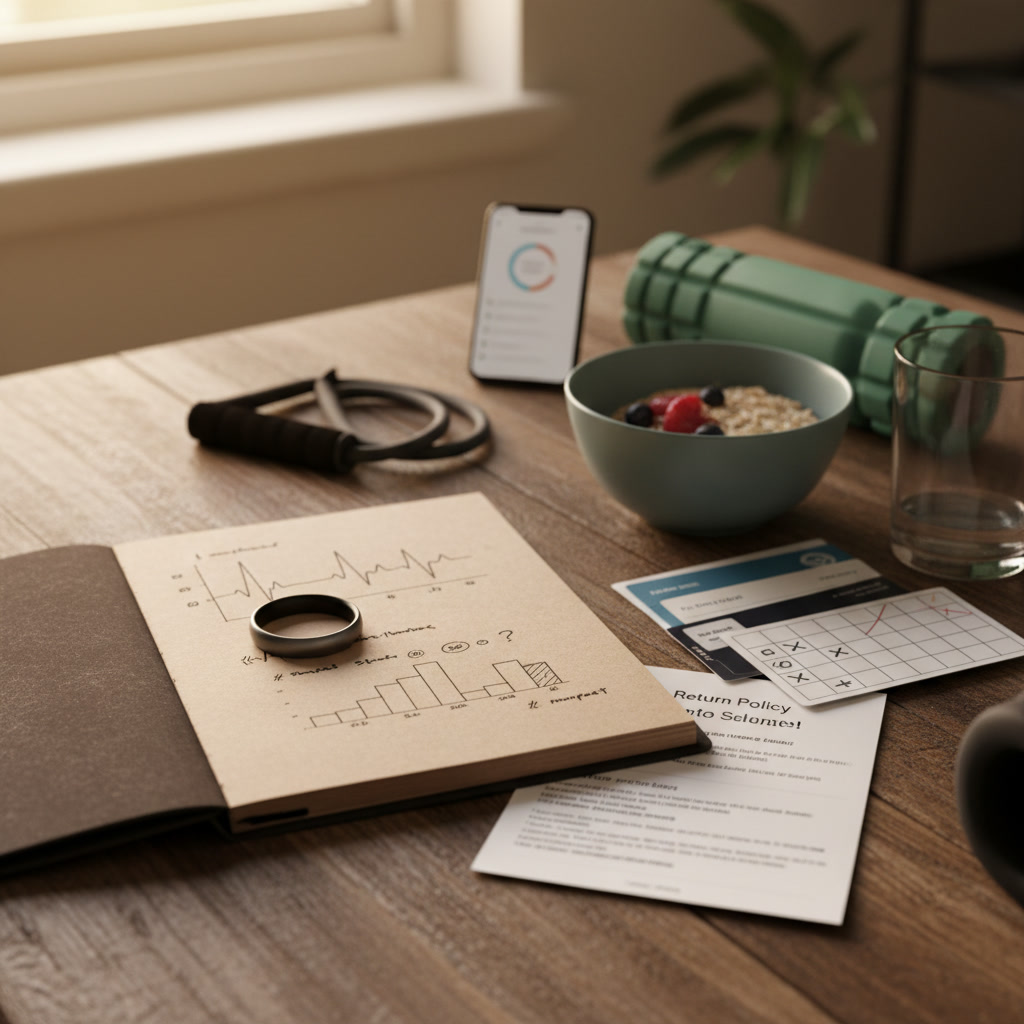
The life constraint comes first; the product claim stays on probation.
Smart rings have become a popular alternative for people who want to monitor their overnight metrics without wearing a bulky smartwatch to bed. By sitting snugly on the finger, these devices measure resting heart rate, skin temperature, and movement, providing a daily snapshot of your overnight recovery. However, understanding how these devices work is crucial to setting realistic expectations. While they are highly capable at tracking basic physiological trends, their ability to accurately map complex sleep architecture is fundamentally limited by their placement on the body.
The core search intent for most people looking into smart rings revolves around accuracy and utility. You want to know if the data justifies the cost, and more importantly, if the sleep stages reported in the companion apps are reliable. The short answer is that smart rings are excellent trend monitors but poor clinical diagnostic tools. They rely on proxy metrics to guess what your brain is doing. Recognising these boundaries helps you use the data to support your daily routines without falling into the trap of over-analysing every minor fluctuation in your sleep score.
How Finger-Based Sensors Actually Measure Sleep
To understand the limitations of a smart ring, it helps to understand the hardware inside it. Smart rings do not measure sleep directly. Instead, they measure the activity of your autonomic nervous system and infer your sleep state based on those measurements. The primary technologies packed into the inner band of a smart ring include:
- Photoplethysmography (PPG) sensors: These use tiny green, red, and infrared LEDs to shine light into the capillaries of your finger. By measuring how much light bounces back, the ring calculates your heart rate, heart rate variability (HRV), and estimated blood oxygen levels.
- Accelerometers: These detect movement, orientation, and the intensity of your physical shifts throughout the night.
- NTC Temperature sensors: These track minute changes in your skin temperature, which naturally fluctuates as you transition through different phases of rest.
When an app tells you that you slept for seven hours and twenty minutes, it is running the data from these three sensors through a proprietary algorithm. If your heart rate drops, your skin temperature shifts, and the accelerometer records zero movement, the algorithm categorises that block of time as sleep. This works well for basic boundaries—knowing roughly when you fell asleep and when you woke up—but it becomes significantly less precise when attempting to break that sleep down into distinct neurological phases.
The Sleep Staging Illusion
The most common frustration with smart rings is the discrepancy in sleep staging—specifically the division of your night into Light, Deep, and REM (Rapid Eye Movement) sleep. In a clinical setting, sleep architecture is measured using polysomnography (PSG). A PSG study involves attaching electrodes to your scalp to measure brain waves (EEG), alongside sensors for eye movement and muscle tension. Brain waves are the only definitive way to know exactly which stage of sleep a person is experiencing.
Because a smart ring is located on your finger, it has no access to your brain waves. It relies entirely on secondary physical signs. For example, during REM sleep, your breathing and heart rate often become irregular, and your skeletal muscles experience temporary paralysis. The ring detects the erratic heart rate and the lack of movement, compares it to a vast database of other users, and estimates that you are in REM sleep.
While algorithmic estimates have improved, they remain educated guesses. Independent validation studies frequently show that consumer wearables struggle to accurately distinguish between light sleep and REM sleep, or they may misinterpret a period of quiet wakefulness (lying completely still in bed) as light sleep. Relying too heavily on the exact minutes of Deep or REM sleep reported by a ring can lead to unnecessary frustration, as the margin of error for these specific metrics is notable.
Physical and Hardware Limitations
Beyond the algorithms, the physical nature of wearing a computer on your finger presents its own set of practical challenges. A ring requires a precise fit to gather accurate data. If the sensors do not sit flush against the skin, the PPG light leaks, and the data becomes compromised.
Human fingers are not static. Finger circumference changes based on hydration levels, alcohol consumption, sodium intake, and ambient temperature. In a climate like Melbourne, where a cold winter night can contrast sharply with a heavily heated bedroom, you might find a ring that fits perfectly at 9:00 PM feels uncomfortably tight—or entirely loose—by 3:00 AM. Nocturnal swelling can make the ring difficult to remove in the morning, while a loose fit will result in gaps in your sleep graph.
Battery degradation is another unavoidable reality. Smart rings contain incredibly small lithium-ion batteries. Due to the frequent charging cycles required to keep them running, the battery capacity naturally degrades over time. A ring that lasts five days on a single charge when new may only hold a charge for two days after eighteen to twenty-four months of continuous use. Since the battery cannot be replaced, the lifespan of the device is inherently limited.
The Risk of Orthosomnia and Data Fatigue
Having access to granular daily health metrics can sometimes work against your wellbeing. Orthosomnia is a documented condition where an individual develops an unhealthy obsession with achieving perfect sleep scores, to the point where the anxiety about the data actually causes insomnia and degrades sleep quality.
The psychological impact of a sleep score is powerful. You might wake up feeling rested and energetic, only to open your smart ring app and see a "poor" recovery score due to a brief spike in overnight heart rate. For many people, seeing that low score triggers a nocebo effect—they suddenly feel fatigued, irritable, and convinced they had a terrible night. The data overrides their own physical sensation of rest.
If checking your sleep data creates anxiety, or if you find yourself altering your daily routine out of fear of a bad score rather than listening to your body, the device has ceased to be a helpful tool. The goal of tracking is to identify broad lifestyle patterns, not to grade your unconscious hours.
Who Should Skip Smart Ring Tracking
General information only, not medical advice. Always consult a qualified healthcare professional regarding persistent health issues or before making significant changes to your health routines.
While smart rings are useful for the general population looking to monitor baseline habits, there are specific circumstances where purchasing or relying on one is counterproductive or potentially harmful. You should reconsider using a smart ring for sleep tracking if you fall into any of the following categories:
- Diagnosed or suspected sleep apnea: A smart ring cannot diagnose sleep apnea, nor can it reliably track the severity of apneic events. If you experience chronic loud snoring, gasping for air during the night, or severe daytime fatigue, skip the consumer wearables and request a referral to a sleep physician for a clinical sleep study.
- Chronic insomnia or severe health anxiety: If you already struggle to fall asleep or stay asleep, adding a device that measures your failure to sleep will likely heighten your anxiety. The pressure to "perform" for the tracker often exacerbates insomnia.
- Eating disorders or obsessive exercise patterns: Many smart rings also track daily calorie burn, step counts, and activity levels. If you have a history of disordered eating or exercise compulsion, the constant presence of these metrics on your finger can trigger harmful behavioural loops.
- Pregnancy: During pregnancy, a person's baseline resting heart rate, blood volume, and body temperature shift dramatically. Consumer sleep algorithms are generally not calibrated for these physiological changes, which means the ring will frequently misinterpret a healthy pregnant body as being highly stressed or poorly recovered, leading to inaccurate and alarming scores.
- Certain cardiovascular medications: Beta-blockers and other medications that artificially regulate heart rate will fundamentally alter the HRV and resting heart rate data the ring collects, rendering the recovery algorithms inaccurate.
Practical Ways to Use the Data
If you understand the limitations and still find value in unobtrusive tracking, there are highly practical ways to integrate a smart ring into your routine. The most effective approach is to ignore the daily score and focus entirely on your personal baselines and long-term trends.
Focus on your resting heart rate (RHR) and heart rate variability (HRV) over a rolling seven-day or fourteen-day period. If your baseline RHR is usually 55 beats per minute, and you notice it has drifted up to 65 for three consecutive nights alongside a drop in HRV, your body is signalling increased systemic stress. This could be due to a heavy training block, an impending viral illness, or excessive late-night alcohol consumption. Using the data as a gentle warning to prioritise hydration and an early bedtime is highly effective.
Similarly, use the ring to audit your sleep consistency rather than your sleep stages. Look at the times you fall asleep and wake up. Building a consistent circadian rhythm—going to bed and waking up within the same thirty-minute window every day, including weekends—is one of the most impactful changes you can make for your overall energy levels. A smart ring is an excellent, objective tool for keeping you honest about your actual bedtime.
Frequently Asked Questions
Do smart rings emit harmful radiation?
Smart rings use Bluetooth Low Energy (BLE) to sync data to your smartphone. The non-ionising radiation emitted by BLE devices is exceptionally low—significantly lower than the smartphone you carry in your pocket. Many rings also offer an "airplane mode" that turns off all Bluetooth transmissions overnight, storing the data locally on the ring until you manually sync it the next morning.
Can a smart ring tell me if I am getting sick?
While it cannot diagnose an illness, a smart ring is very good at detecting the physiological stress that precedes symptoms. A sudden spike in overnight skin temperature combined with an elevated resting heart rate is often a leading indicator that your immune system is fighting off a pathogen, sometimes alerting you a day or two before you feel a sore throat or fatigue.
How tight should a sleep ring be?
The fit should be snug enough that the sensors remain in constant contact with the skin underneath your finger, but loose enough that it can be twisted off with a little resistance. It should not cause pain, restrict blood flow, or leave deep indentations on your skin. If your finger swells significantly overnight, you may need to switch the ring to a slightly smaller finger before bed.